WELCOME TO EHUMAN RESOURCE SERVICES
On behalf of your colleagues, we welcome you to EHuman Resource Services and wish you every success here.
At EHuman Resource Services, we believe that each employee contributes directly to the growth and success of the company, and we hope you will take pride in being a member of our team.
This handbook was developed to describe some of the expectations of our employees and to outline the policies, programs, and benefits available to eligible employees. Employees should become familiar with the contents of the employee handbook as soon as possible, for it will answer many questions about employment with EHuman Resource Services.
We believe that professional relationships are easier when all employees are aware of the culture and values of the organization. This guide will help you to better understand our vision for the future of our business and the challenges that are ahead.
We hope that your experience here will be challenging, enjoyable, and rewarding.
Again, welcome!
Q.Ellick
Table of Contents
- Organization Description
- Products and Services Provided
- Facilities and Location
- Mission and Vision
- Introductory Statement
- Customer Relations
1.1 ORGANIZATION DESCRIPTION
1.1.1 PRODUCTS AND SERVICES PROVIDED
You will find more information about our products and services by reading the eHUMAN RESOURCE SERVICES Corporate website: www.ehrsgroup.com
1.1.2 FACILITIES AND LOCATION
eHuman Resource Service: Recruiting, Training, and Staffing
Main Office
No. 10 Magsaysay Drive
Brgy. New Asinan
Olongapo City, Zambales, 2200
Temporary Office
#4 Alba Street
Olongapo City, Zambales, 2200
Philippines
Contact Details
Globe :+63(945)342-4817
Smart :+63(968)642-4542
Email: hr@ehrsgroup.com/info@ehrsgroup.com
Website: www.ehrsgroup.com
Social Media Accounts
Facebook Page: https://www.facebook.com/ehrsgroup
Facebook Group:https://www.facebook.com/groups/ehrsgroup
Facebook Messenger: https://m.me/ehrsgroup
1.1.3 MISSION and VISION
Establish Client relationship based on effective communication, unwavering integrity, and a commitment to excellence. Develop those relationships into long term engagements through service that exceeds client expectations in all respects. Translate those relationships into stakeholder value through Fiscal Prudence, Industry Leadership, and Intelligence Growth.
Foster performance achievement, operational brilliance, and employee satisfaction through commitment to professional excellence. Inspire the eHuman Resource Services team to create value through great management measured by operational success combined with ongoing employee enrichment.
Create a uniquely positive experience for our clients and/or their customers. Actively contribute to a productive, invigorating work environment based on mutual respect, dedication and professionalism.
Extend our commitment to include communities where in our facilities are located. Promote economic prosperity and its benefits beyond our stakeholder through meaningful civic participation
1.2 INTRODUCTORY STATEMENT
This handbook is designed to acquaint you with eHuman Resource Services and provide you with information about working conditions, employee benefits, and some of the policies affecting your employment. You should read, understand, and comply with all provisions of the handbook. It describes many of your responsibilities as an employee and outlines the programs developed by eHuman Resource Services to benefit employees. One of our objectives is to provide a work environment that is conducive to both personal and professional growth
No employee handbook can anticipate every circumstance or question about policy. As eHuman Resource Services continues to grow, the need may arise and eHuman Resource Services reserves the right to revise, supplement, or rescind any policies or portion of the handbook from time to time as it deems appropriate, in its sole and absolute discretion. Employees will be notified of such changes to the handbook as they occur.
1.3 CUSTOMER RELATIONS
Customers are among our organization’s most valuable assets. Every employee represents eHuman Resource Services to our customers and the public. The way we do our jobs presents an image of our entire organization. Customers judge all of us by how they are treated with each employee contact. Therefore, one of our first business priorities is to assist any customer or potential customer. Nothing is more important than being courteous, friendly, helpful, and prompt in the attention you give to customers.
eHuman Resource Services will provide customer relations and services training to all employees with extensive customer contact. Customers who wish to lodge specific comments or complaints should be directed to the Account Manager for appropriate action. Our personal contact with the public, our manners on the telephone, and the communications we send to customers are a reflection not only of ourselves, but also of the professionalism of eHuman Resource Services. Positive customer relations not only enhance the public’s perception or image of eHuman Resource Services also pay off in greater customer loyalty and increased sales and profit.
Table of Contents
- Nature of Employment
- Employee Relations
- Equal Employment Opportunity
- Business Ethics and Conduct
- Personal Relationships in the Workplace
- Conflicts of Interest
- Outside Employment
- Non-disclosure
- Job Postings and Employee Referrals
2.1 NATURE OF EMPLOYMENT
Employment with eHuman Resource Services is voluntarily entered into, and the employee is free to resign once a formal resignation is passed with probable cause. Similarly, eHuman Resource Services may terminate the employment relationship at will at any time, alongside appropriate notice or cause, so long as there is no violation of applicable national or provincial law.
Policies set forth in this handbook are not intended to create a contract, nor are they to be construed to constitute contractual obligations of any kind or a contract of employment between eHuman Resource Services and any of its employees. The provisions of the handbook have been developed at the discretion of management and, except for its policy of employment-at-will, may be amended or cancelled at any time, at eHuman Resource Services’ sole discretion.
These provisions supersede all existing policies and practices and may not be amended or added to without the express written approval of the Board of Directors.
2.2 EMPLOYEE RELATIONS
eHuman Resource Services believes that the work conditions, wages, and benefits it offers to its employees are competitive with those offered by other employers in this area and in this industry. If employees have concerns about work conditions or compensation, they are strongly encouraged to voice these concerns openly and directly to their supervisors.
Our experience has shown that when employees deal openly and directly with supervisors, the work environment can be excellent, communications can be clear, and attitudes can be positive. We believe that eHuman Resource Services amply demonstrates its commitment to employees by responding effectively to employee concerns.
In an effort to protect and maintain direct employer/employee communications, we will do anything we can to protect the right of employees to speak for them.
2.3 EQUAL EMPLOYMENT OPPORTUNITY
In order to provide equal employment and advancement opportunities to all individuals, employment decisions at eHuman Resource Services will be based on merit, qualifications, and abilities. eHuman Resource Services does not discriminate in employment opportunities or practices based on race, color, religion, sex, national origin, age, or any other characteristic protected by law.
This policy governs all aspects of employment, including selection, job assignment, compensation, discipline, termination, and access to benefits and training.
Any employees with questions or concerns about any type of discrimination in the workplace are encouraged to bring these issues to the attention of their immediate supervisor or the Human Resources/ Work Force Department. Employees can raise concerns and make reports without fear of reprisal. Anyone found to be engaging in any type of unlawful discrimination will be subject to disciplinary action, up to and including termination of employment.
2.4 BUSINESS ETHICS AND CONDUCT
The successful business operation and reputation of eHuman Resource Services is built upon the principles of fair dealing and ethical conduct of our employees. Our reputation for integrity and excellence requires careful observance of the spirit and letter of all applicable laws and regulations, as well as a scrupulous regard for the highest standards of conduct and personal integrity.
The continued success of eHuman Resource Services is dependent upon our customers’ trust and we are dedicated to preserving that trust. Employees owe a duty to eHuman Resource Services, its customers, and shareholders to act in a way that will merit the continued trust and confidence of the public.
eHuman Resource Services will comply with all applicable laws and regulations and expects its directors, officers, and employees to conduct business in accordance with the letter, spirit, and intent of all relevant laws and to refrain from any illegal, dishonest, or unethical conduct.
In general, the use of good judgment, based on high ethical principles, will guide you with respect to lines of acceptable conduct. If a situation arises where it is difficult to determine the proper course of action, the matter should be discussed openly with your immediate supervisor and, if necessary, with the Director of Operations for advice and consultation.
Compliance with this policy of business ethics and conduct is the responsibility of every eHuman Resource Services employee. Disregarding or failing to comply with this standard of business ethics and conduct could lead to disciplinary action, up to and including possible termination of employment.
2.5 PERSONAL RELATIONSHIPS IN THE WORKPLACE
The employment of relatives or individuals involved in a dating relationship in the same area of an organization may cause serious conflicts and problems with favoritism and employee morale. In addition to claims of partiality in treatment at work, personal conflicts from outside the work environment can be carried over into day-to-day working relationships.
For purposes of this policy, a relative is any person who is related by blood or marriage, or whose relationship with the employee is similar to that of persons who are related by blood or marriage. A dating relationship is defined as a relationship that may be reasonably expected to lead to the formation of a consensual “romantic” or sexual relationship. This policy applies to all employees without regard to the gender or sexual orientation of the individuals involved.
Although eHuman Resource Services has no prohibition against employing relatives of current employees or individuals involved in a dating relationship with current employees, we are committed to monitoring situations in which such relationships exist in the same area. In case of actual or potential problems, eHuman Resource Services will take prompt action, and this can include reassignment. Employees in a close personal relationship should refrain from public workplace displays of affection or excessive personal conversation.
2.6 CONFLICTS OF INTEREST
Employees have an obligation to conduct business within guidelines that prohibit actual or potential conflicts of interest. This policy establishes only the framework within which eHuman Resource Services wishes the business to operate. The purpose of these guidelines is to provide general direction so that employees can seek further clarification on issues related to the subject of acceptable standards of operation. Contact the Human Resources Department and/or Executive Department for more information or questions about conflicts of interest.
Transactions with outside firms must be conducted within a framework established and controlled by the executive level of eHuman Resource Services. Business dealings with outside firms should not result in unusual gains for those firms. Unusual gain refers to bribes, product bonuses, special fringe benefits, unusual price breaks, and other windfalls designed to ultimately benefit the employer, the employee, or both. Promotional plans that could be interpreted to involve unusual gain require specific executive-level approval.
An actual or potential conflict of interest occurs when an employee is in a position to influence a decision that may result in a personal gain for that employee or for a relative because of eHuman Resource Services business dealings. For the purposes of this policy, a relative is any person who is related by blood or marriage, or whose relationship with the employee is similar to that of persons who are related by blood or marriage.
No “presumption of guilt” is created by the mere existence of a relationship with outside firms. However, if employees have any influence on transactions involving purchases, contracts, or leases, it is imperative that they disclose to an officer of eHuman Resource Services as soon as possible the existence of any actual or potential conflict of interest so that safeguards can be established to protect all parties.
Personal gain may result not only in cases where an employee or relative has a significant ownership in a firm with which eHuman Resource Services does business, but also when an employee or relative receives any kickback, bribe, substantial gift, or special consideration as a result of any transaction or business dealings involving eHuman Resource Services.
2.7 OUTSIDE EMPLOYMENT
Employees may hold outside jobs as long as they meet the performance standards of their job with eHuman Resource Services and is not on the same industry that the company is into in order to prevent conflict of interest. All employees will be judged by the same performance standards and will be subject to eHuman Resource Services scheduling demands, regardless of any existing outside work requirements.
If eHuman Resource Services determines that an employee’s outside work interferes with performance or the ability to meet the requirements of eHuman Resource Services as they are modified from time to time, the employee may be asked to terminate the outside employment if he or she wishes to remain with eHuman Resource Services.
Outside employment that constitutes a conflict of interest is prohibited. Employees may not receive any income or material gain from individuals outside eHuman Resource Services for materials produced or services rendered while performing their jobs.
2.8 NON-DISCLOSURE
The protection of confidential business information and trade secrets is vital to the interests and the success of eHuman Resource Services. Such confidential information includes, but is not limited to, the following examples:
| * Compensation data | * Pending projects and proposals |
| * Computer processes | * Proprietary production processes |
| * Computer programs and codes | * Research and development strategies |
| * Customer lists | * Scientific data |
| * Customer preferences | * Scientific formulae |
| * Financial information | * Scientific prototypes |
| * Labor relations strategies | * Technological data |
| * Marketing strategies | * Technological prototypes |
| * New materials research |
All employees are required to sign a non-disclosure agreement as a condition of employment. Employees who improperly use or disclose trade secrets or confidential business information will be subject to disciplinary action, up to and including termination of employment and legal action, even if they do not actually benefit from the disclosed information.
2.9 JOB POSTING AND EMPLOYEE REFERRALS
eHuman Resource Services provides employees an opportunity to indicate their interest in open positions and advance within the organization according to their skills and experience. In general, notices of all regular, full-time job openings are posted, although eHuman Resource Services reserves its discretionary right to not post a particular opening.
Job openings will be posted on the employee bulletin board and/or in the e-mail system, and normally remain open for 15 days. Each job posting notice will include the dates of the posting period, job title, department, location, grade level (exempt or nonexempt), job summary, essential duties, and qualifications (required skills and abilities).
To be eligible to apply for a posted job, employees must have performed competently for at least 90 calendar days in their current position. Employees who have a written warning on file, or are on probation or suspension are not eligible to apply for posted jobs. Eligible employees can only apply for those posted jobs for which they possess the required skills, competencies, and qualifications.
To apply for an open position, employees should submit a job posting internal application form (see Annex 2: Internal Application Form) to their immediate supervisor listing job-related skills and accomplishments. It should also describe how their current experience with eHuman Resource Services and prior work experience and/or education qualifies them for the position.
eHuman Resource Services recognizes the benefit of developmental experiences and encourages employees to talk with their supervisors about their career plans. Supervisors are encouraged to support employees’ efforts to gain experience and advance within the organization.
An applicant’s supervisor may be contacted to verify performance, skills, and attendance. Any staffing limitations or other circumstances that might affect a prospective transfer may also be discussed.
Job posting is a way to inform employees of openings and to identify qualified and interested applicants who might not otherwise be known to the hiring manager. Other recruiting sources may also be used to fill open positions in the best interest of the organization.
eHuman Resource Services also encourages employees to identify friends or acquaintances that are interested in employment opportunities and refer qualified outside applicants for posted jobs. Employees should obtain permission from the individual before making a referral, share their knowledge of the organization, and not make commitments or oral promises of employment.
An employee should submit the referral’s resume and/or completed application form to Human Resources Department for a posted job. If the referral is interviewed, the referring employee will be notified of the initial interview and the final selection decision.
3.1 EMPLOYMENT CATEGORIES
It is the intent of eHuman Resource Services to clarify the definitions of employment classifications so that employees understand their employment status and benefit eligibility.
Each employee is designated as either NONEXEMPT or EXEMPT from national and provincial wage and hour laws. NONEXEMPT employees are entitled to overtime pay under the specific provisions of national and provincial laws. EXEMPT employees are excluded from specific provisions of national and provincial wage and hour laws. An employee’s EXEMPT or NONEXEMPT classification may be changed only upon written notification by eHuman Resource Services management.
In addition to the above categories, each employee will belong to one other employment category:
REGULAR FULL-TIME employees are those who are not in a temporary or probation status and who are regularly scheduled to work eHuman Resource Services full-time schedule. Generally, they are eligible for eHuman Resource Services benefit package, subject to the terms, conditions, and limitations of each benefit program.
REGULAR PART-TIME employees are those who are not assigned to a temporary or probation status and who are regularly scheduled to work less than 28 hours per week. While they do receive all legally mandated benefits (such as SSS, Pag-Ibig and PhilHealth), they are ineligible for all of EHuman Resource Services other benefit programs.
PROBATION is those whose performance is being evaluated to determine whether further employment in a specific position or with EHuman Resource Services is appropriate. Employees who satisfactorily complete the probation period will be notified of their new employment classification.
TRAINING is where an individual takes part in a trainee program within eHuman Resource Services and is being trained to the job they were originally hired for. A trainee become an official employee after completing probation.
FLOATING employees are employees who are temporarily suspended, temporarily laid-off, or temporarily retrenched from employment. He/ She remains to be an employee of the company due to the nature of being on floating status.
CONTRACTUAL employees are those who are hired as interim replacements, to temporarily supplement the work force, or to assist in the completion of a specific project. Employment assignments in this category are of a limited duration. Employment beyond any initially stated period does not in any way imply a change in employment status. Temporary employees retain that status unless and until notified of a change. While temporary employees receive all legally mandated benefits (such as SSS, Pag-ibig, and PhilHealth), they are ineligible for all of eHuman Resource Services other benefit programs.
APPRENTICE employees are those who took the apprenticeable programs offered by eHuman Resource Services. They will receive 75% of the prevailing wage and is entitled to have the same benefits as that of the regular employees such as SSS, Pag-Ibig and PhilHealth). Also, they are ineligible for all of eHuman Resource Services other benefit programs.
CASUAL employees are those who have established an employment relationship with eHuman Resource Services but who are assigned to work on an intermittent and/or unpredictable basis. While they receive all legally mandated benefits (such as SSS, Pag-Ibig, and PhilHealth), they are ineligible for all of eHuman Resource Services other benefit programs.
3.2 ACCESS TO PERSONNEL FILES
eHuman Resource Services maintains a personnel file on each employee. The personnel file includes such information as the employee’s job application, resume, records of training, documentation of performance appraisals and salary increases, and other employment records.
Personnel files are the property of eHuman Resource Services, and access to the information they contain is restricted. Generally, only supervisors and management personnel of eHuman Resource Services who have a legitimate reason to review information in a file are allowed to do so.
Employees who wish to review their own file should contact the Human Resources Department. With reasonable advance notice, employees may review their own personnel files in eHuman Resource Services offices and in the presence of an individual appointed by eHuman Resource Services to maintain the files.
3.3 PERSONNEL DATA CHANGES
It is the responsibility of each employee to promptly notify eHuman Resource Services of any changes in personnel data. Personal mailing addresses, telephone numbers, number and names of dependents, individuals to be contacted in the event of emergency, educational accomplishments, and other such status reports should be accurate and current at all times. If any personnel data has changed, notify the Human Resources Department.
3.4 TRAINING AND PROBATION PERIOD
The probation period is intended to give new employees the opportunity to demonstrate their ability to achieve a satisfactory level of performance and to determine whether the new position meets their expectations. eHuman Resource Services uses this period to evaluate employee capabilities, work habits, and overall performance.
All new and rehired employees work on a training period for the first 30-45 calendar days after their date of hire. Employee will be on a probationary status of 60 days once completion for training has been completed. Any significant absence will automatically extend the probation period by the length of the absence. If eHuman Resource Services determines that the designated probation period does not allow sufficient time to thoroughly evaluate the employee’s performance, the probation period may be extended for a specified period.
Upon satisfactory completion of the probation period, employees enter the “regular” employment classification.
During the probation period, new employees are eligible for those benefits that are required by law, such as Pag-Ibig, Phil Health and Social Security. After becoming regular employees, they may also be eligible for other EHuman Resource Services -provided benefits, subject to the terms and conditions of each benefits program. Employees should read the information for each specific benefits program for the details on eligibility requirements.
3.5 EMPLOYMENT APPLICATIONS
eHuman Resource Services relies upon the accuracy of information contained in the employment application, as well as the accuracy of other data presented throughout the hiring process and employment. Any misrepresentations, falsifications, or material omissions in any of this information or data may result in the exclusion of the individual from further consideration for employment or, if the person has been hired, termination of employment.
3.6 PERFORMANCE EVALUATION, APPRAISAL AND PROMOTION.
3.6.1 PERFORMANCE EVALUATION
Supervisors and employees are strongly encouraged to discuss job performance and goals on an informal, day-to-day basis. Additional formal performance evaluations are conducted to provide both supervisors and employees the opportunity to discuss job tasks, identify and correct weaknesses, encourage and recognize strengths, and discuss positive, purposeful approaches for meeting goals.
After the employee has completed his probation period of 3 months, to be done quarterly, the immediate supervisor evaluates the performance of the employee and makes necessary adjustments if necessary.
The annual salary review of all employees is based on performance and is evaluated beginning the month of December and effective First Full Pay Period of January of the preceding year.
3.6.2 PERFORMANCE APPRAISAL
- All employees of eHuman Resource Services should receive written feedback about their performance at least once a year by way of a performance evaluation. Client Contact Specialists and Team Leaders will be appraised bi-annually.
- A performance appraisal form, the company’s evaluation tool, will show a comparison of actual performance with pre-established expectations.
- Information contained in a performance evaluation is personal and must be treated with great sensitivity. Written evaluations will be kept confidential.
- Evaluations must be completed before determinations about any action affecting the employee, i.e. salary increases, promotions, movements, training, separation, etc., are made for the new year.
- HR will provide ongoing support in the development and implementation of performance appraisal through the provision of: appraisal forms, individual coaching on implementation, as well as on the completion of individual forms.
See Performance Appraisal Form and Instructions for Staffs, Supervisors and Managers on Annex 3.
3.6.3 PROMOTION
In order to ensure equitable rates of pay for employees when employee movements that impact pay occur. eHuman Resource Services had set the policy for promotion; consequently, during the course of employment, an employee may be placed in other positions within his department or in other areas of the organization. Transfer, upgrade and promotion selections are based upon the operational needs of eHuman Resource Services; and its various units, and the employee’s qualifications. Advancement to a new position before an employee has mastered the responsibilities of the present position and contributed to the operation and continuity of the present department is disadvantageous both to the Company and to the employee.
Decisions regarding employee movement are based upon the following criteria:
- The employee must have worked at least 6 months in current job.
- The employee must fully meet job requirements, as outlined in the job description.
- The employee must not have committed disciplinary violations throughout his employment with the Company
- The employee must have met expectations on his/her most recent performance review.
- The employee must have an acceptable attendance record throughout his employment with the Company.
A promotion occurs when an employee moves to a job in a higher pay grade or when his or her job is reassessed to a higher pay grade. In such cases, the employee is eligible for an increase that is reflective of the change in responsibilities.
An upgrade occurs when there are special circumstances surrounding an employee such as his significant professional growth, or there was an increased complexity in his current job. An upgrade may also occur when an employee transfers to another position within the same job level with a different pay grade.
A lateral transfer occurs when an employee transfers to another position in the same pay grade as the position the employee previously occupied. In such cases, the employee shall not be eligible for a pay increase at the time of such a transfer.
Salary Rates:
- Promotion: The department head, together with HR, will determine the promotional increase percentage of the employee. The employee’s pay shall typically be adjusted at least 10% for each pay grade shift not to exceed 30% or the minimum of the new pay grade, whichever is greater. The actual percentage will vary based on market/industry conditions, employee performance, and funding considerations. Promotion-based salary adjustments are in addition to merit increases if the promotion is made at the time of the annual salary adjustment.
- Upgrade: Increases for upgrades may range from 7% to 10% of basic pay. An employee may not receive an upgrade increase until he has been on eHuman Resource Services payroll for at least 90 days, and may receive no more than one in-position increase over a two-year period.
- In-position: In-position increases may range from 5% to 7% of the employee’s basic pay. This type of increase is given apart from the annual merit increase. It can also be given any time of the year, and not necessarily timed during the annual performance appraisal exercise.
A salary increase must not create salary inequities and is only done in extraordinary situations. Also, all salary increases must have prior written approval before a commitment may be made to the employee. The Company will not honor any promise of salary increases made by the supervisor to the concerned employee without the required approvals.
Criteria:
The employee must undergo a performance appraisal to qualify for a promotion; his rating must not be lower than a 4: an Exceeds Expectations rating.
Promotion and Upgrade: The amount of the promotion or upgrade increase is based on an application of the criteria outlined below:
- The employee’s past performance versus job expectations and in comparison, to the new peer group.
- The importance of the job’s skills and responsibilities to the organization’s objectives.
- The employee’s skill level relative to that desired for the new position and in comparison, to the skills of other employees performing the same or highly similar work.
- The degree of change in job complexity, duties, responsibilities (including management responsibilities), and potential impact on the achievement of objectives.
- The employee’s performance appraisal rating to qualify for the promotion must be at least a 4 (exceeds expectations).
In-position increase: A detailed written justification for the in-position increase must be completed and approved by the appropriate supervisor and department head and submitted to HR prior to the action being effective. Eligibility for an in-position increase and the amount of the increase are based on some or all of the criteria outlined below:
- An employee’s position has become substantially more difficult through assignment of complex projects or other work.
- The technical complexity of an employee’s position has increased substantially by requirements to address technological advances, new theories and practices in the employee’s area of expertise.
- There is evidence of significant professional attainments that enable the employee to perform his or her current job more effectively.
- An employee’s performance substantially exceeds the expectations of his current position.
- If the employee’s position is managerial, the group that he directs has assumed missions that are more complex, and/or the organization directed has grown substantially in size or complexity.
- In-position increases may also be granted to achieve parity with highly specialized labor markets.
When it is practical and feasible, a vacancy should be filled internally from existing eligible employees. Please refer to the Internal Job Application Policy for guidance.
3.6.4 INTERNAL JOB APPLICATION
eHuman Resource Services is dedicated to assisting employees reach their professional goals through internal promotion and transfer opportunities. One of the tools the company makes available to employees in managing their career is eHuman Resource Services’ internal job posting. This procedure enables current employees to apply for any available internal position.
These directions provide guidance for employees who wish to apply for internal jobs and career opportunities within the organization.
To apply for an opening:
Step 1: Ensure that you meet the following eligibility requirements.
- You are a current, regular full-time employee.
- You have been in your current position for at least six months. (Exceptions to this six-month requirement can be made by your current supervisor and should be consistent with company business needs.)
- Your performance meets established work standards in your current position.
- You have not had an administrative case, employee counseling or corrective action within the past six months. You are not undergoing a performance improvement plan for your current position.
- You meet the qualifications listed for the position on the job posting.
Step 2: Complete an Internal Job Application form. (Annex 2). Applications are attached to this policy; please print and fill out the form. Attach your resume to the completed application.
Step 3: Submit the Internal Job Application to your supervisor for approval.
Step 4: Submit your completed and approved Internal Job Application to HR.
Step 5: Candidates who are qualified will participate in an initial interview with the supervisor of the position. Finalists will participate in two additional interviews, with an HR recruiter and with an internal customer of the position or a manager. The selected person will be notified by the supervisor of the position.
3.6.5 90 DAY EVALUATION PERIOD
The employee selected for the position will undergo an evaluation period of three months after which his performance will be appraised to determine whether he has met the expectations required of the job. If the expectations have been met, the accompanying salary increase awarded to the employee will bring their salary to the entry salary level of the job range, and will be effective on the date the individual assumed the position. As in all cases of employee movements, any increases will be done in accordance with Company guidelines.
3.6.6 TURNOVER PROTOCOL
It is the sole duty of the employee to systematically turn over his/ her duties and responsibilities properly to his supervisor or replacement before exiting the company.
Said employee should lay down and explain his daily routine and procedure to his/ her successor in a period of 30 days or less or depending on how effective turn over would come about.
Every document should be surrendered as well as important files to be used by the successor or supervisor.
3.7 JOB DESCRIPTIONS
eHuman Resource Services makes every effort to create and maintain accurate job descriptions for all positions within the organization. Each description includes a job information section, a job summary section (giving a general overview of the job’s purpose), an essential duties and responsibilities section, a supervisory responsibilities section, a qualifications section (including education and/or experience, language skills, mathematical skills, reasoning ability, and any certification required), a physical demands section, and a work environment section.
eHuman Resource Services maintains job descriptions to aid in orienting new employees to their jobs, identifying the requirements of each position, establishing hiring criteria, setting standards for employee performance evaluations, and establishing a basis for making reasonable accommodations for individuals with disabilities.
The Human Resources Department and the hiring manager prepare job descriptions when new positions are created. Existing job descriptions are also reviewed and revised in order to ensure that they are up to date. Job descriptions may also be rewritten periodically to reflect any changes in the position’s duties and responsibilities. All employees will be expected to help ensure that their job descriptions are accurate and current, reflecting the work being done.
Employees should remember that job descriptions do not necessarily cover every task or duty that might be assigned, and that additional responsibilities may be assigned as necessary. Contact the Human Resources Department if you have any questions or concerns about your job description.
3.8 SALARY ADMINISTRATION
The salary administration program at eHuman Resource Services was created to achieve consistent pay practices, comply with national and provincial laws, mirror our commitment to Equal Employment Opportunity, and offer competitive salaries within our labor market. Because recruiting and retaining talented employees is critical to our success, eHuman Resource Services is committed to paying its employees equitable wages that reflect the requirements and responsibilities of their positions and are comparable to the pay received by similarly situated employees in other organizations in the area.
Compensation for every position is determined by several factors, including job analysis and evaluation, the essential duties and responsibilities of the job, and salary survey data on pay practices of other employers. eHuman Resource Services periodically reviews its salary administration program and restructures it as necessary. Merit-based pay adjustments may be awarded in conjunction with superior employee performance documented by the performance evaluation process. Incentive bonuses may be awarded depending on the overall profitability of eHuman Resource Services and based on each employee’s individual contributions to the organization.
Employees should bring their pay-related questions or concerns to the attention of their immediate supervisors, who are responsible for the fair administration of departmental pay practices. The accounting department is also available to answer specific questions about the salary administration program.
4.1 EMPLOYEE BENEFITS
Eligible employees at eHuman Resource Services are provided a wide range of benefits. A number of the programs cover all employees in the manner prescribed by law.
Benefits eligibility is dependent upon a variety of factors, including employee classification. Your supervisor can identify the programs for which you are eligible. Details of many of these programs can be found elsewhere in the employee handbook.
The following benefit programs are available to eligible employees:
- Regular full-time employees
Eligible employees are provided with the following benefits:
- Social Security System (SSS)
- PhilHealth
- Pag-Ibig
4.2 HOLIDAYS
eHuman Resource Services will grant holiday time off to all employees where the program is based on the holidays listed below:
US Holiday List
| New Year’s Day | January 1st |
| Martin Luther King Day | 3rd Monday in January |
| Director of Operations’ Day | 3rd Monday in February |
| Memorial Day | Last Monday in May |
| Independence Day | July 4th |
| Labor Day | 1st Monday in September |
| Columbus Day | 2nd Monday in October |
| Veterans Day | November 10th |
| Thanksgiving Day | 4th Thursday in November |
| Christmas Day | December 25th |
UK Holiday List
| 2023 | |
| New Year’s Day | January 1st |
| Good Friday | April 7th |
| Easter Monday | April 10th |
| Early May Bank Holiday | May 1st |
| Spring bank holiday | May 29th |
| Summer bank holiday | August 28th |
| Christmas Day | December 25th |
| Boxing Day | December 26th |
AUS Holiday List
| 2023 | |
| New Year’s Day | January 1st |
| Australia Day | January 26th |
| Canberra Day | March 14th |
| Good Friday | April 7th |
| Easter Saturday | April 9th |
| Easter Monday | April 10th |
| Anzac Day | April 25th |
| Queen’s Birthday | June 13th |
| Family and Community Day | September 28th |
| Labour Day | March 6th |
| Christmas Day | December 25th |
| Boxing Day | December 26th |
PH Holiday List
Philippine 12 regular holidays, which are:
| 2023 | |
| New Year’s Day | January 1st |
| Maundy Thursday | April 6th |
| Good Friday | April 7th |
| Araw ng Kagitingan | April 9th – or nearest Monday |
| Labor Day | May 1st – or nearest Monday |
| Independence Day | June 12th – or nearest Monday |
| National Heroes Day | August 29th |
| Bonifacio Day | November 30th – or nearest Monday |
| Eid ul-Fitr | April 22nd |
| Eid-Ul-Adha | June 28th |
| Christmas Day | December 25th |
| Rizal Day | December 30th – or nearest Monday |
Philippine Special Days
We have 3 special days:
| All Saints Day | November 1st |
| Last Day of the Year | December 31st |
| Ninoy Aquino Day | August 21st |
eHuman Resource Services will grant paid holiday time off to all eligible employees immediately upon assignment to an eligible employment classification. Holiday pay will be calculated based on the employee’s straight-time pay rate (as of the date of the holiday) times the number of hours the employee would otherwise have worked on that day. Eligible employee classification(s):
On Philippine Holiday, pay would be received by an employee on the occasion of a regular holiday or special day.
In the case of regular holiday, the employee is paid even if no work is made. Employee receives double the pay if the employee reported to work during regular holiday.
In the case of a special day, the employee is not paid if employee does not report for work. But if the employee works on a special day, entitlement to 130% of the usual pay received.
If a statutory holiday falls during an eligible employee’s paid absence (such as personal leave), holiday pay will be provided instead of the paid time off benefit that would otherwise have applied.
If eligible nonexempt employees work on a recognized holiday, they will receive holiday pay plus wages at one and one-half times their straight-time rate for the hours worked on the holiday.
Paid time off for holidays will not be counted as hours worked for the purposes of determining overtime.
4.3 WORKERS INSURANCE
eHuman Resource Services provides insurance program to employees. This program covers any injury or illness sustained in the course of employment that requires medical, surgical, or hospital treatment. Subject to applicable legal requirements, workers’ compensation insurance provides benefits after a short waiting period or, if the employee is hospitalized, immediately.
Employees who sustain work-related injuries or illnesses should inform their supervisor immediately. No matter how minor an on-the-job injury may appear, it is important that it be reported immediately. This will enable an eligible employee to qualify for coverage as quickly as possible.
Neither eHuman Resource Services nor the insurance carrier will be liable for the payment of workers’ compensation benefits for injuries that occur during an employee’s voluntary participation in any off-duty recreational, social, or athletic activity sponsored by eHuman Resource Services.
4.4 PERSONAL LEAVE BENEFITS
eHuman Resource Services provides paid personal leave benefits to all eligible employees for periods of temporary absence due to illnesses or injuries. Eligible employee classification(s):
* Regular full-time employees
Eligible employees will accrue on a pro-rated basis personal leave benefits at the rate of 6 days per year. Personal leave benefits are calculated based on a “calendar year,” the 12-month period that begins when the employee starts to earn personal leave benefits.
Paid personal leave can be used in minimum increments of one half-day. An eligible employee may use personal leave benefits for an absence due to his or her own illness or injury, or that of a child, parent, or spouse of the employee or at any reasonable cause.
Employees who are unable to report to work due to illness or injury or other personal reasons should notify their direct supervisor and company gateway before the scheduled start of their workday if possible. The direct supervisor must also be contacted on each additional day of absence. If an employee is absent for three or more consecutive days due to illness or injury, a physician’s statement may need to be provided verifying the disability and its beginning and expected ending dates. Such verification may be requested for other personal leave absences as well and may be required as a condition to receiving personal leave benefits.
Personal leave benefits will be calculated based on the employee’s base pay rate at the time of absence and will not include any special forms of compensation, such as incentives, commissions, bonuses, or shift differentials. As an additional condition of eligibility for personal leave benefits, an employee on an extended absence must apply for any other available compensation and benefits. Personal leave benefits will be used to supplement any payments that an employee is eligible to receive from provincial disability insurance, workers’ compensation or eHuman Resource Services-provided disability insurance programs. The combination of any such disability payments and personal leave benefits cannot exceed the employee’s normal weekly earnings.
Personal leave benefits are intended solely to provide income protection in the event of illness or injury, and any reasonable cause for absence. Unused personal leave benefits will not be convertible to cash. Employees who quit or that are terminated are not entitled to be paid any unused sick days upon termination of employment.
4.5 BEREAVEMENT LEAVE
Employees who require taking time off due to the death of an immediate family member should notify their supervisor immediately.
Paid bereavement leave will be provided to employees having worked 60 calendar days for eHuman Resource Services:
- Five (5) working days in the case of the death of an employee’s spouse, child or the employee’s spouse’s child.
- Three (3) working days in the case of the death of an employee’s father, mother, sister or brother.
- One (1) working day in the case of the death of an employee’s grandfather, grandmother, uncle, aunt, nephew, niece, son-in-law, daughter-in-law, father-in-law, mother-in-law, brother-in-law, sister-in-law, grandson, grand-daughter (except the uncle, the aunt, the brother-in-law, the sister-in-law, the grandfather, the grandmother, the nephew and the niece of the spouse).
Bereavement pay is calculated based on the base pay rate at the time of absence and will not include any special forms of compensation, such as incentives, commissions, bonuses, or shift differentials. The employees on leave without balance, of maternity, disease, in preventive withdrawal, parental leave, will not be able to prevail themselves of this benefit.
Bereavement leave will normally be granted unless there are unusual business needs or staffing requirements. Employees may, with their supervisors’ approval, use any available paid leave for additional time off as necessary.
4.6 VACATION LEAVE
Paid annual vacation is available to eligible employees to provide opportunities for rest, relaxation, and personal pursuits. All employees are eligible to earn and use vacation time as described in this policy:
The amount of paid vacation time employees receives each year increases with the length of their employment as shown in the following schedule:
- Upon initial eligibility, the employee is entitled to a maximum of five vacation days each year or one vacation day per month of service to a maximum of five days, if the employee has less than 1 year of service as of the end of the reference period, which is calculated from January to December.
- After two years of eligible service, the employee is entitled to ten vacation days each year.
- After three years of eligible service, the employee is entitled to fifteen vacation days each year.
Once employees enter an eligible employment classification, they begin to earn paid vacation time according to the schedule. However, before vacation time can be used, a waiting period of 90 calendar days must be completed. After that time, employees can request use of earned vacation time including that accrued during the waiting period.
Paid vacation time can be used in minimum increments of one day. To take vacation, employees should request advance approval from their supervisors. Requests will be reviewed based on a number of factors, including business needs and staffing requirements.
Vacation time off is paid at the employee’s pay rate at the time of vacation. It includes overtime or any special forms of compensation such as incentives, commissions, bonuses, or shift differentials. It does not include Christmas bonuses or gifts.
As stated above, employees are encouraged to use available paid vacation time for rest, relaxation, and personal pursuits. In the event that available vacation is not used by the end of the reference period, the balance of unused vacation will not be paid out to the employee.
Vacation will leave will not be convertible to cash. Employees who quit or that are terminated are note entitled to be paid vacation days upon termination of employment.
4.7 RELOCATION BENEFITS
When eHuman Resource Services asks employees to relocate to a new area, certain relocation benefits may be provided to facilitate the transition. Relocation may be available to any eligible transferred employee who must relocate in order to reside within 45 miles of the new place of work. For specific information regarding the terms and extent of relocation benefits, discuss with your immediate supervisor.
Employees must request relocation assistance for specific items in advance of the date the expenses are incurred. eHuman Resource Services will reimburse expenses only if the employee has received advance approval, incurs reasonable expenses, and submits satisfactory proof of the expense within 30 calendar days of the date the expense was incurred.
eHuman Resource Services extends these relocation benefits in an effort to contribute to the success of every employee’s relocation. However, if an employee separates from eHuman Resource Services service within one year of the relocation, the amount of the relocation reimbursement will be considered only a loan. Accordingly, the employee will be asked to reimburse all relocation expense.
4.8 EDUCATIONAL ASSISTANCE
eHuman Resource Services recognizes that the skills and knowledge of its employees are critical to the success of the organization. The educational assistance program encourages personal development through formal education so that employees can maintain and improve job-related skills or enhance their ability to compete for reasonably attainable jobs within eHuman Resource Services.
eHuman Resource Services will provide educational assistance to all eligible employees immediately upon assignment to an eligible employment classification. To maintain eligibility employees must remain on the active payroll and be performing their job satisfactorily through completion of each course. Only Regular full-time employees are eligible for educational assistance.
Employees should contact their immediate supervisor or the Human Resources Department for more information or questions about educational assistance.
While educational assistance is expected to enhance employees’ performance and professional abilities, eHuman Resource Services cannot guarantee that participation in formal education will entitle the employee to automatic advancement, a different job assignment, or pay increases.
4.9 HEALTH INSURANCE
eHuman Resource Services health insurance plan provides employees and their dependents access to medical insurance benefits. Employees in the following employment classifications are eligible to participate in the health insurance plan:
- Regular full-time employees
Eligible employees may participate in the health insurance plan subject to all terms and conditions of the agreement between eHuman Resource Services and the insurance carrier.
For details of the PhilHealth health insurance such as cost of coverage, please contact the Human Resources Department for more information about health insurance benefits.
4.10 MARRIAGE, MATERNITY AND PARENTAL LEAVE
4.10.1 MARRIAGE
One (1) paid working day off is allowed for the marriage of the employee or one of his children. An employee may take one (1) day leave of absence for the marriage of a parent, brother, sister or child of joint sound.
4.10.2 Maternity Leave
eHuman Resource Services shall grant any pregnant woman employees who has rendered an aggregate service of at least six months for the last twelve months, maternity leave of at least two weeks prior to the expected date of delivery and another four weeks after normal delivery or abortion, with full pay based on her regular or average weekly wages.
A qualified pregnant woman employee shall be entitled maternity leave of at least two weeks prior to expected date of delivery and another four weeks after normal delivery or abortion. That’s a total of six weeks maternity leave.
- Leave Extension
Maternity leave may be extended on account of illness arising out of the pregnancy, delivery, abortion or miscarriage, which renders the woman unfit for work. Extended maternity leave is without pay, but may be charged against any unused leave credits.
- Maternity Benefits under SSS Law
A pregnant woman member of SSS who has paid at least three, monthly contributions in the twelve-month period immediately preceding the semester of her childbirth or miscarriage shall be paid a daily maternity benefit.
- Amount
SSS maternity benefit shall be equivalent to 100% of the pregnant employee’s average daily salary credit for 60 days, or 78 days in case of caesarian delivery.
- Time of payment
The full payment of maternity benefits shall be advanced by the employer within 30 days from the filing of the maternity leave application.
- Payment Disbursement
The SSS shoulders the payment of maternity benefits. As per procedure payment is to be initially advanced by eHuman Resource Services, subject to immediate reimbursement by SSS.
- Checklist for Availment
- The pregnant woman employee must have paid at least three, monthly contributions within the 12-month period immediately preceding the semester of her childbirth or miscarriage.
- She has given the required notification of her pregnancy through eHuman Resource Services.
- Valid marriage not required
- Checklist for Availment
Unlike in paternity leave where valid marriage is a requisite for availment, the existence of a valid marriage is not required to avail of maternity leave benefits.
- Limitation on Availment
Entitlement to maternity leave under the Labor Code and maternity benefits under the SSS Law applies only for the first four delivery.
- Bar to recovery of sickness benefits.
That payment of daily maternity benefits is a bar to the recovery of SSS sickness benefits for the same period for which daily maternity benefits have been received.
4.10.3 PATERNITY LEAVE
Paternity leave refers to the benefits granted to a married male employee EHuman Resource Services allowing him to take a leave for 7 days, with full pay, for the first 4 deliveries of his legitimate spouse with whom he is cohabiting.
Conditions for Entitlement to Paternity Leave
- The employee is lawfully married;
- He is cohabiting with his legitimate wife;
- His wife is pregnant or has delivered a child or suffered a miscarriage or abortion;
- Must be of the first four deliveries;
- The employer is notified within reasonable time of the pregnancy and of date of expected delivery (not required in case of abortion or miscarriage).
When Paternity Leave may be Availed of
The paternity benefit may be availed of before, during or after delivery, provided the total number of days does not exceed 7 working days. For example, the employee may take a leave of 2 days before delivery, 1 day during delivery, and another 4 days after delivery. However, the benefit must be availed of not later than 60 days after date of delivery.
Limitation
The benefit may be availed of only for the first four deliveries.
Commutability to Cash
Paternity leave is not commutable to cash if not availed of.77
5.1 TIMEKEEPING
Accurately recording time worked is the responsibility of every nonexempt employee. National and state/provincial laws require eHuman Resource Services to keep an accurate record of time worked in order to calculate employee pay and benefits. Time worked is all the time actually spent on the job performing assigned duties.
Timekeeping in eHuman Resource Services is done by the use of Timetrex- a software that allows real-time timekeeping supervision. All employees are to log in/out during their fifteen (15) minute breaks and one (1) hour lunch breaks. Timetrex is also utilized for filing leave requests which will be granted upon the approval of immediate supervisor and the Director of Operations.
The revision of Timetrex records is only applicable to the Workforce department who is respectively in-charge of employee scheduling. Altering of aforementioned time records can only be done if supplied with a valid reason that has been approved by the Director of Operations.
5.2 PAYDAYS
All employees are paid semi-monthly. To which payroll is paid twice a month, usually on the 16th and first day of the month. Each paycheck will include earnings for all work performed through the end of the previous payroll period to which applicable deductions for all government contributions are already made.
In the event that a regularly scheduled payday falls on a day off such as a weekend or holiday, employees will receive pay on the last day of work after the regularly scheduled payday.
Employees may have their pay directly deposited into their bank accounts if they provide advance written authorization to eHuman Resource Services. Employees will receive a paystub itemized statement of wages when eHuman Resource Services makes direct deposits.
5.3 EMPLOYMENT TERMINATION
Termination of employment is an inevitable part of personnel activity within any organization, and many of the reasons for termination are routine. Below are examples of some of the most common circumstances under which employment is terminated:
- Resignation – voluntary employment termination initiated by an employee.
- Discharge – involuntary employment termination initiated by the organization.
- Layoff – involuntary employment termination initiated by the organization for non-disciplinary reasons.
- Retirement – voluntary employment termination initiated by the employee meeting age, length of service, and any other criteria for retirement from the organization.
5.4 ADMINISTRATIVE PAY CORRECTIONS
eHuman Resource Services takes all reasonable steps to ensure that employees receive the correct amount of pay in each paycheck and that employees are paid promptly on the scheduled payday.
In the unlikely event that there is an error for pay, the employee should promptly fill out a Personnel Action Form (Annex 4: PAF Form) on the discrepancy portion and submit to their immediate supervisor. The immediate supervisor will then log a ticket for attaching the form assigning to the Finance Department who will adjust the corrections on the following cut off.
5.5 CASH ADVANCES
eHuman Resource Services offers their employees cash advance programs. In order to be qualified, they need to have a 2-week perfect attendance and a formal request must be submitted via “Timetrex Request form” which will be reviewed by the supervisor.first
6.1 WORK SCHEDULES
The normal work schedule for all employees is nine (9) hours a day, six (6) times a week. Employees are advised through Timetrex and their immediate supervisor the times their schedules will normally begin and end. Staffing needs and operational demands may necessitate variations in starting and ending times, as well as variations in the total hours that may be scheduled each day and week.
Flexible scheduling, or flextime, is available in some cases to allow employees to vary their starting and ending times each day within established limits. Flextime may be possible if a mutually workable schedule can be negotiated with the supervisor involved. However, such issues as staffing needs, the employee’s performance, and the nature of the job will be considered before approval of flextime. Employees should consult their supervisor to request participation in the flextime program.
6.2 USE OF PHONE AND MAIL SYSTEM
Personal use of the telephone for long-distance and toll calls is not permitted. Employees should practice discretion when making local personal calls and may be required to reimburse eHuman Resource Services for any charges resulting from their personal use of the telephone.
The use of eHuman Resource Services-paid postage for personal correspondence is not permitted.
To ensure effective telephone communications, employees should always use an approved greeting and speak in a courteous and professional manner. Please confirm information received from the caller, and hang up only after the caller has done so.
6.3 DRUG-, ALCOHOL-, AND TOBACCO-FREE WORKPLACE POLICY
eHuman Resource Services is implementing a drug, alcohol and tobacco-free policy for all employees, and visitors in order to provide a clean, healthy, productive, and safe environment for all.
PURPOSE AND GOAL
eHuman Resource Services is committed to protecting the safety, health and well-being of all employees and other individuals in our workplace. We recognize that alcohol abuse and drug use pose a significant threat to our goals. We have established a tobacco-, drug-, and alcohol-free workplace policy that balances our respect for individuals with the need to maintain an alcohol, tobacco and drug-free environment. eHuman Resource Services encourages employees to voluntarily seek help with drug and alcohol problems.
COVERED WORKERS
Any individual who conducts business for eHuman Resource Services or is conducting business on the contact center’s property is covered by our drug- tobacco- and alcohol-free workplace policy. Our policy applies to all eHuman Resource Services employees on all shifts and is not limited to managers, supervisors, full-time employees, On-The-Job trainees, off-site employees, apprentices, clients, consultants, contractors, and all other visitors; and members of committees, including our Board of Directors.
APPLICABILITY
Our drug-free workplace policy is intended to apply whenever anyone is representing or conducting business for eHuman Resource Services. Therefore, this policy applies during and after work hours which includes, whenever conducting business or representing the contact center, while on call, paid standby, while on contact center property, owned and/or leased locations/premises; all internal and external areas, parking garages, and parking lots; all entrances and exits; and all company owned and/or leased vehicles. Additionally, the policy will be in place at all company sponsored events—both on our premises and at external locations.
Employees who choose to use tobacco products must do so on their regularly scheduled breaks or meal periods only and off company property as stated above. No ashtrays are permitted in any indoor or outdoor area on company premises.
PROHIBITED BEHAVIOR
It is a violation of our drug-free workplace policy to possess, sell, consume, or be under the influence of alcoholic beverages or legal and/or illegal drugs while on contact center premises, during working hours outside the office, or while on contact center business, or in a contact center vehicle. An employee who is using prescription or over-the-counter drugs that may impair the employee’s ability to safely perform the job, or affect the safety or well-being of others, must notify their supervisor of such use immediately before starting or resuming work.
CONSEQUENCES
One of the goals of our drug-free workplace program is to encourage employees to voluntarily seek help with alcohol tobacco and/or drug problems. If, however, an individual violates the policy, the consequences are serious. eHuman Resource Services shall not discharge, refuse to hire, retaliate against an employee, applicant, or customer who exercises any rights afforded by this policy, or anyone who reports or attempts to prosecute a violation of this policy. Compliance with this policy is mandatory and policy violations by employees will be subject to the standard disciplinary actions of the company.
Violation of the Drug-, Tobacco-, and Alcohol-Free Workplace Policy will result in disciplinary action at the contact center’s discretion, up to and including immediate termination of employment. An employee required to enter rehabilitation who fails to successfully complete it and/or repeatedly violates the policy will be terminated from employment. Nothing in this policy prohibits the employee from being disciplined or discharged for other violations and/or performance problems.
ASSISTANCE
eHuman Resource Services recognizes that alcohol, tobacco and drug abuse addiction are treatable illnesses. We also realize that early intervention and support improve the success of rehabilitation.
To support our employees, our drug-free workplace policy:
- Encourages employees to seek help if they are concerned that they or their family members may have a drug and/or alcohol problem
- Encourages employees to utilize the services of qualified professionals in the community to assess the seriousness of suspected drug or alcohol problems and identify appropriate sources of help
- Allows the use of accrued personal leave while seeking treatment for alcohol and other drug problems
- Treatment for tobacco smoking or chewing, alcoholism and/or other drug use disorders may be covered by the employee benefit plan. However, the ultimate financial responsibility for recommended treatment belongs to the employee.
CONFIDENTIALITY
All information received by the contact center through the drug-free workplace program is confidential communication. Access to this information is limited to those who have a legitimate need to know in compliance with relevant laws and management policies.
EXCEPTIONS
Occasional exceptions to this policy against the consumption of alcoholic beverages may be made at eHuman Resource Services’ sole discretion for small quantities of such beverages reasonable under the circumstances, usually wine or beer, which may be available at social events. At such events, all employees are expected to exercise good judgment and moderation. All employees are expected to comply fully with all laws (including laws prohibiting the operation of motor vehicles while under the influence of alcohol), and to take safety precautions including arranging for safe transportation from the event.
6.4 SICKNESS PREVENTION AND CONTROL IN THE WORKPLACE POLICY
eHuman Resource Services is implementing COVID-19, Hepatitis B, HIV/AIDS, Tuberculosis, aware workplace for all employees, and visitors in order to provide healthy, productive and safe environment for all.
PURPOSE AND GOAL
eHuman Resource Services is committed in protecting the safety, health, and well-being of all employees and other individuals in our workplace.
ASSISTANCE
eHuman Resource Services understands that illnesses are treatable conditions. We also recognize that early intervention and support significantly enhance the chances of achieving a sickness-free outcome.
DISCRIMINATION-FREE WORKPLACE
eHuman Resource Services prohibits discrimination against employees based on their medical status, whether they are currently infected or have been in the past.
CONFIDENTIALITY
All information disclosed to the eHuman Resource Services through HR for OSH related program is confidential communication. Access to this information is limited to those who have a legitimate need to know in compliance with relevant laws and management policies.
6.5 MEAL PERIODS
All employees are provided with one meal period of 60-minute or a 30-minute in length each workday. They will also be given two 15 minutes break throughout the day. Supervisors will schedule meal periods to accommodate operating requirements. The said schedule will be forwarded to Workforce to be plotted on their Timetrex. Employees will be relieved of all active responsibilities and restrictions during meal periods and will only be compensated on the two 15-minute break.
6.6 OVERTIME
When operating requirements or other needs cannot be met during regular working hours, employees will be given the opportunity to volunteer for overtime work assignments. All overtime work must receive the supervisor’s prior authorization. Overtime assignments will be distributed as equitably as practical to all employees qualified to perform the required work.
Overtime compensation is paid to all non-exempt employees in accordance with national and provincial wage and hour restrictions. Overtime pay is based on actual hours worked. Time off on personal leave, vacation leave, or any leave of absence will not be considered hours worked for purposes of performing overtime calculations. Failure to work scheduled overtime or overtime worked without prior authorization from the supervisor may result in disciplinary action, up to and including possible termination of employment.
6.7 USE OF EQUIPMENT
Equipment essential in accomplishing job duties is often expensive and may be difficult to replace. When using property, employees are expected to exercise care, perform required maintenance, and follow all operating instructions, safety standards, and guidelines.
Please notify the supervisor if any equipment, machines, or tools appear to be damaged, defective, or in need of repair. Prompt reporting of damages, defects, and the need for repairs could prevent deterioration of equipment and possible injury to employees or others. The supervisor can answer any questions about an employee’s responsibility for maintenance and care of equipment used on the job.
The improper, careless, negligent, destructive, or unsafe use or operation of equipment can result in disciplinary action, up to and including termination of employment. Payment of equipment will be deducted from their final pay check if equipment is not replaced.
6.8 EMERGENCY CLOSING
At times, emergencies such as severe weather, fires or power failures, can disrupt company operations. In extreme cases, these circumstances may require the closing of a work facility.
When operations are officially closed due to emergency conditions, the time off from scheduled work will be unpaid. However, with supervisory approval, employees may use available paid leave time, such as unused vacation benefits.
In cases where an emergency closing is not authorized, employees who fail to report for work will not be paid for the time off. Employees in essential operations may be asked to work on a day when operations are officially closed. In these circumstances, employees who work will receive regular pay.
6.7 BUSINESS TRAVEL EXPENSES
eHuman Resource Services will reimburse employees for reasonable business travel expenses incurred while on assignments away from the normal work location. All business travel must be approved in advance by the immediate supervisor and Accounting Department.
Employees whose travel plans have been approved should make all travel arrangements through eHuman Resource Services Accounting Department. When approved, the actual costs of travel, meals, lodging, and other expenses directly related to accomplishing business travel objectives will be reimbursed and/or be released a budget by eHuman Resource Services. Employees are expected to limit expenses to reasonable amounts.
Expenses that generally will be reimbursed include the following:
- Airfare or any public vehicle fare for travel in coach or economy class or the lowest available fare.
- Car rental fees, only for compact or mid-sized cars.
- Fares for shuttle or airport bus service, where available; costs of public transportation for other ground travel.
- Taxi fares, only when there is no less expensive alternative.
- Mileage costs for use of personal cars, only when less expensive transportation is not available.
- Cost of standard accommodations in low to mid-priced hotels, motels, or similar lodgings.
- Cost of meals, no more lavish than would be eaten at the employee’s own expense.
- Charges for telephone calls, fax, and similar services required for business purposes.
- Charges for one personal telephone call each day.
- Charges for laundry and services, only on trips of five or more days. (Personal entertainment and personal care items are not reimbursed.)
Employees are encouraged to use their cellular telephone or calling cards when traveling, as hotel charges are excessive.
Employees who are involved in an accident while traveling on business must promptly report the incident to their immediate supervisor. Vehicles owned, leased, or rented by eHuman Resource Services may not be used for personal use without prior approval.
Cash/Check to cover reasonable anticipated expenses may be made to employees, after travel has been approved. Employees should submit a ticket request to their supervisor when travel advances are needed. The immediate supervisor will then be reassigning the ticket with note of approval to the Accounting Department within seventy-two (72) hours before date of travel.
When travel is completed, employees should submit completed travel expense reports with official receipts and change within twenty-four (24) hours upon arrival. Reports should be accompanied by receipts for all individual expenses.
Employees should contact their supervisor for guidance and assistance on procedures related to travel arrangements, travel advances, expense reports, reimbursement for specific expenses, or any other business travel issues.
Abuse of this business travel expenses policy, including falsifying expense reports to reflect costs not incurred by the employee, can be grounds for disciplinary action, up to and including termination of employment.
6.8 VISITORS IN THE WORKPLACE
To provide for the safety and security of employees and the facilities at eHuman Resource Services, only authorized visitors are allowed in the workplace. Restricting unauthorized visitors helps maintain safety standards, protects against theft, ensures security of equipment, protects confidential information, safeguards employee welfare, and avoids potential distractions and disturbances.
All visitors should enter eHuman Resource Services at the reception area. Authorized visitors will receive directions or be escorted to their destination. Employees are responsible for the conduct and safety of their visitors.
If an unauthorized individual is observed on eHuman Resource Services premises, employees should immediately notify their supervisor or, if necessary, direct the individual to the reception area.
6.9 COMPUTER AND E-MAIL USAGE
Computers, computer files, the e-mail system, and software furnished to employees are eHuman Resource Services property intended for business use. Employees should not use a password, access a file, or retrieve any stored communication without authorization. To ensure compliance with this policy, computer and e-mail usage may be monitored.
eHuman Resource Services strives to maintain a workplace free of harassment and sensitive to the diversity of its employees. Therefore, eHuman Resource Services prohibits the use of computers and the e-mail system in ways that are disruptive, offensive to others, or harmful to morale.
For example, the display or transmission of sexually explicit images, messages, and cartoons is not allowed. Other such misuse includes, but is not limited to, ethnic slurs, racial comments, off-color jokes, or anything that may be construed as harassment or showing disrespect for others.
E-mail may not be used to solicit others for commercial ventures, religious or political causes, outside organizations, or other non-business matters.
Particular care must be taken when using email, eHuman Resource Services’ internal message boards such as, Slack and Skype, as a means of communication because all expressions of fact, intention and opinion in an email may bind you and/or eHuman Resource Services’ and can be produced in court in the same way as other kinds of written statements.
6.10 INTERNET USAGE
Internet access to global electronic information resources on the World Wide Web is provided by eHuman Resource Services to assist employees in obtaining work-related data and technology. The following guidelines have been established to help ensure responsible and productive Internet usage. While Internet usage is intended for job-related activities, incidental and occasional brief personal use is permitted within reasonable limits.
All Internet data that is composed, transmitted, or received via our computer communications systems is considered to be part of the official records of eHuman Resource Services and, as such, is subject to disclosure to law enforcement or other third parties. Consequently, employees should always ensure that the business information contained in Internet e-mail messages and other transmissions is accurate, appropriate, ethical, and lawful.
The equipment, services, and technology provided to access the Internet remain at all times the property of eHuman Resource Services. As such, eHuman Resource Services reserves the right to monitor Internet traffic, and retrieve and read any data composed, sent, or received through our online connections and stored in our computer systems.
Data that is composed, transmitted, accessed, or received via the Internet must not contain content that could be considered discriminatory, offensive, obscene, threatening, harassing, intimidating, or disruptive to any employee or other person. Examples of unacceptable content may include, but are not limited to, sexual comments or images, racial slurs, gender-specific comments, or any other comments or images that could reasonably offend someone on the basis of race, age, sex, religious or political beliefs, national origin, disability, sexual orientation, or any other characteristic protected by law.
The unauthorized use, installation, copying, or distribution of copyrighted, trademarked, or patented material on the Internet is expressly prohibited. As a rule, if an employee did not create the material, does not own the rights to it, or has not gotten authorization for its use, it should not be put on the Internet. Employees are also responsible for ensuring that the person sending any material over the Internet has the appropriate distribution rights.
Internet users should take the necessary anti-virus precautions before downloading or copying any file from the Internet. All downloaded files are to be checked for viruses; all compressed files are to be checked before and after decompression.
Abuse of the Internet access provided by eHuman Resource Services in violation of law or eHuman Resource Services policies will result in disciplinary action, up to and including termination of employment. Employees may also be held personally liable for any violations of this policy. The following behaviors are examples of previously stated or additional actions and activities that are prohibited and can result in disciplinary action:
- Sending or posting discriminatory, harassing, or threatening messages or images
- Using the organization’s time and resources for personal gain
- Stealing, using, or disclosing someone else’s code or password without authorization
- Copying, pirating, or downloading software and electronic files without permission
- Sending or posting confidential material, trade secrets, or proprietary information outside of the organization
- Violating copyright law
- Failing to observe licensing agreements
- Engaging in unauthorized transactions that may incur a cost to the organization or initiate unwanted Internet services and transmissions
- Sending or posting messages or material that could damage the organization’s image or reputation
- Participating in the viewing or exchange of pornography or obscene materials
- Sending or posting messages that defame or slander other individuals
- Attempting to break into the computer system of another organization or person
- Refusing to cooperate with a security investigation
- Sending or posting chain letters, solicitations, or advertisements not related to business purposes or activities
- Using the Internet for political causes or activities, religious activities, or any sort of gambling
- Jeopardizing the security of the organization’s electronic communications systems
- Sending or posting messages that disparage another organization’s products or services
- Passing off personal views as representing those of the organization
- Sending anonymous e-mail messages
- Engaging in any other illegal activities
6.11 WORKPLACE MONITORING
Workplace monitoring may be conducted by eHuman Resource Services to ensure quality control, employee safety, security, and customer satisfaction.
Employees who regularly communicate with customers may have their telephone conversations monitored or recorded. Telephone monitoring is used to identify and correct performance problems through targeted training. Improved job performance enhances our customers’ image of eHuman Resource Services as well as their satisfaction with our service.
Computers furnished to employees are the property of eHuman Resource Services. As such, computer usage and files may be monitored or accessed.
Employees can request access to information gathered through workplace monitoring that may impact employment decisions. Access will be granted unless there is a legitimate business reason to protect confidentiality or an ongoing investigation.
Because eHuman Resource Services is sensitive to the legitimate privacy rights of employees, every effort will be made to guarantee that workplace monitoring is done in an ethical and respectful manner.
6.12 WORKPLACE VIOLENCE PREVENTION
eHuman Resource Services is committed to preventing workplace violence and to maintaining a safe work environment. Given the increasing violence in society in general, eHuman Resource Services has adopted the following guidelines to deal with intimidation, harassment, or other threats of (or actual) violence that may occur during business hours or on its premises.
All employees, including supervisors and temporary employees, should be treated with courtesy and respect at all times. Employees are expected to refrain from fighting, “horseplay,” or other conduct that may be dangerous to others.
Conduct that threatens, intimidates, or coerces another employee, a customer, or a member of the public at any time, including off-duty periods, will not be tolerated. This prohibition includes all acts of harassment, including harassment that is based on an individual’s sex, race, age, or any characteristic protected by national, provincial, or local law.
All threats of (or actual) violence, both direct and indirect, should be reported as soon as possible to your immediate supervisor or any other member of management. This includes threats by employees, as well as threats by customers, vendors, solicitors, or other members of the public. When reporting a threat of violence, you should be as specific and detailed as possible.
All suspicious individuals or activities should also be reported as soon as possible to a supervisor. Do not place yourself in peril. If you see or hear a commotion or disturbance near your workstation, do not try to intercede or see what is happening.
eHuman Resource Services will promptly and thoroughly investigate all reports of threats of (or actual) violence and of suspicious individuals or activities. The identity of the individual making a report will be protected as much as is practical. In order to maintain workplace safety and the integrity of its investigation, eHuman Resource Services may suspend employees, either with or without pay, pending investigation.
Anyone determined to be responsible for threats of (or actual) violence or other conduct that is in violation of these guidelines will be subject to prompt disciplinary action up to and including termination of employment.
eHuman Resource Services encourages employees to bring their disputes or differences with other employees to the attention of their supervisors or the Human Resources Department before the situation escalates into potential violence. eHuman Resource Services is eager to assist in the resolution of employee disputes, and will not discipline employees for raising such concerns.
7.1 EMPLOYEE WORK RULES
To ensure orderly operations and provide the best possible work environment, eHuman Resource Services expects employees to follow rules of conduct that will protect the interests and safety of all employees and the organization.
It is not possible to list all the forms of behavior that are considered unacceptable in the workplace. The following are examples of infractions of rules of conduct that may result in disciplinary action, up to and including termination of employment:
- Theft or inappropriate removal or possession of property
- Prior to entering the production floor, it is mandatory to surrender all non-health-related electronic devices to the security team.
- Falsification of timekeeping records
- Working under the influence of alcohol or illegal drugs
- Possession, distribution, sale, transfer, or use of alcohol or illegal drugs in the workplace, while on duty, or while operating employer-owned vehicles or equipment
- Fighting or threatening violence in the workplace
- Boisterous or disruptive activity in the workplace
- Negligence or improper conduct leading to damage of employer-owned or customer-owned property
- Insubordination or other disrespectful conduct
- Violation of safety or health rules
- Sexual or other unlawful or unwelcome harassment
- Possession of dangerous or unauthorized materials, such as explosives or firearms, in the workplace
- Excessive absenteeism or any absence without notice
- Unauthorized use of telephones, mail system, or other employer-owned equipment
- Unauthorized disclosure of business “secrets” or confidential information
- Violation of personnel policies
- Unsatisfactory performance or conduct
7.2 CODE OF CONDUCT
Responsibilities
All employees are expected to comply with instructions, policies, procedures, rules and regulations, and accepted standards of personal conduct. If an employee fails to comply with these requirements, or if performance is below acceptable standards, appropriate disciplinary action should be taken.
Discipline is the administrative responsibility of the employee’s immediate supervisor and department managers. Disciplinary guidelines for eHuman Resource Services’ employees may be found at the end of this handbook (see ANNEX 5: TABLE OF PENALTIES). Though this section outlines the types of disciplinary actions to be imposed, it is not intended to create any expectation that an employee will be assured of any particular form or course of disciplinary action. In determining the appropriate disciplinary action, supervisory personnel may consider facts such as the seriousness of the incident, all surrounding facts and circumstances, including the Company’s best interests, and the employee’s record, including prior discipline.
The Director of Operations, the Corporate Attorney, and employees of the Human Resources Department and Workforce Department have advisory roles in disciplinary matters and should be consulted to ensure legal compliance.
Generally, discipline follows a progressive process which attempts to correct unacceptable behavior or attitudes before it becomes necessary to dismiss the employee. However, any type of disciplinary action may be invoked for a serious first violation of rules. Sections which follow discuss in detail the various disciplinary actions available which include:
- Reprimand (verbal and written)
- Suspension from work without pay
- In-house Suspension (employee is to continue daily work routine but should render an additional 4 hours per day depending on the number of days of his suspension, the additional 4 hours/day is not paid)
- Dismissal
Assuring That the “Just Cause” Standard Has Been Met
Prior to imposing discipline, your supervisor should determine whether “just cause” exists. Just cause is the universally accepted standard by which the appropriateness of disciplinary actions is judged. The following guidelines are useful in determining whether or not that standard has been met:
- Where an employee’s conduct or performance is unacceptable, consider whether or not the employee was adequately warned of the consequences of such conduct or performance.
- To what extent have you made an effort to inform the employee about the Company’s Rules and Regulations, the reason you find his behavior inappropriate or unacceptable, and the consequences of not correcting the inappropriate or unacceptable behavior?
- While an employee is presumed to have adequate warning of the consequences for violating the Company’s Rules and Regulations, did you take the extra step to ensure that the employee was aware of the rules?
- Were adequate warnings for inefficiency, simple negligence, or other behavior which is unacceptable given in the appropriate form (i.e., informal employee counseling, oral or written instructions).
- The supervisor is responsible to impose discipline, investigate the situation before proceeding with the disciplinary process unless immediate action is necessary and should obtain all available facts before taking any action.
- Investigate responsibly.
- Timing is critical. It should not take more than five (5) working days to complete the investigation and administer any appropriate disciplinary action after the incident or after the supervisor learns about the incident.
- Avoid over-reaction. Consider, seek out, and listen to all sides of the story. Where at all possible, obtain statements from employees or other persons who were a witness to an incident. If verbal or written statements are obtained from witnesses, ensure these persons swear or affirm that what they have said or written is true and accurate to the best of their knowledge.
- Although not all situations can be covered in the Company’s Table of Penalties, supervisors must review the types of offenses to determine which category a particular act or trend of inappropriate or unacceptable behavior fits in. The type of discipline given can depend on several factors:
- How long has the employee worked for the Company?
- Was the current problem an isolated incident or was it part of an emerging or continuing pattern of discipline infractions?
- What has been the quality of the employee’s past performance?
- Consistency in the application of discipline is absolutely essential in order to avoid allegations of favoritism or discrimination. The Company’s Rules must be applied even-handedly and without discrimination.
Grounds for Discipline
Disciplinary action may be taken against an employee for any behavior which may discredit the Company, its officers, directors and or its employees, or might hinder the Company from effectively performing its functions. By way of illustration, but not limitation, the following constitute reasonable grounds for discipline:
- habitual or gross neglect of duty
- absence without leave
- incompetence or unwillingness to render satisfactory service, as shown by evaluation ratings below the satisfactory standard
- insubordination or serious breach of discipline
- improper use of, or being under the influence of alcohol, or controlled substances while on duty
- conduct unbecoming an employee which tends to bring the Company into disrepute
- noncompliance with Company rules, regulations, and other personnel or departmental rules
- conviction of a felony, crime of moral turpitude or any offense involving sexual molestation, physical or sexual abuse or rape
- negligence or willful damage of Company property or waste of supplies or equipment
- use of bribery or political pressure to secure appointment or advantage
- falsification of an application
- immorality
- misappropriation of funds or property
- sexual harassment
Process Preceding Discipline of Regular Employees
Initial Steps
When a department manager receives the recommendation of a supervisor that an employee shall be disciplined other than by reprimand, the manager shall meet with the employee before imposing any disciplinary action, if needed. All efforts must be exhausted to encourage employees to improve behavior through dialogue, counseling and other remedial action.
- At the meeting with the employee, the manager shall explain the charges and the evidence supporting those charges and shall give the employee an opportunity to present his/her version of the events.
- After this meeting, if the manager determines that disciplinary action is appropriate, he shall notify the employee in writing of the action being taken and the reasons, including reference to any specific rules that may have been violated.
Preventive Suspension
In a situation, where the employee poses a serious and continuing danger to persons or company property, or an ongoing threat of disrupting work activity, the employee may be preventively suspended for a period not exceeding thirty (30) days, pending results of the investigation of his case. In such cases, the Company endeavors to terminate the due process requirements on or before the 30th day of suspension. If the Company decides to extend the preventive suspension beyond thirty (30) days, it may do so, provided that the employee shall be entitled to compensation already during the extended period. During the period of suspension, the employee will not be entitled to any compensation. However, if after investigation, the Company decides that the employee did not commit any infraction, the employee shall be entitled to a reimbursement of the compensation due him/her during the period of suspension. The employee shall be advised in writing of the order of suspension.
Preventive suspension should not be confused with the suspension to be imposed as a form or penalty. Preventive suspension is merely an intermediate protective measure.
Discipline Process
- Fact-Finding
When it is determined that an employee’s conduct may have breached a Company rule or standard, the employee’s supervisor will make a prompt and detailed investigation of the facts and may seek a more detailed explanation from the individual. It may include examination of relevant documents and a fact- finding interview from the employee being investigated, or from other parties who may able to shed light on the case at hand. The supervisor handling the case will write to the employee setting out details of the allegation.
- Fact-Finding
- Answer and Hearing
After giving the employee a reasonable period to reply to the show cause letter, the Company may decide on the matter, based on the evidence on hand. However, for offenses which contemplate dismissal/termination as a penalty, the Company shall send another letter to the employee, setting the schedule for the conduct of a hearing. During the hearing, the Company shall afford the employee ample opportunity to be heard and to present evidence on his behalf; he is likewise entitled to be accompanied by a representative, if he wishes.Further, any other witnesses or persons whom the Company has interviewed or has provided information on the incident shall also be invited to attend the hearing to afford the employee the opportunity to confront them. In cases other than those for which termination is the proposed penalty, the Company, at its discretion, may still decide to conduct a hearing after receiving the employee’s reply.
Failure on the part of the employee to reply to the show cause letter within a reasonable period, or his unexplained failure to attend the hearing, shall constitute a waiver of his right to be heard.
- Answer and Hearing
- Decision
If the Company decides to penalize or terminate an employee, the employee must receive in writing the Company’s decision and the reasons for such. This shall be served personally to the employee, or by mailing it by registered mail to the employee to his last known address.
Disciplinary Actions
Reprimand
An employee may be reprimanded by his supervisor, or any of his superiors in the chain of authority in the department or Company. Reprimands may be either verbal or written.
Verbal Reprimand
The verbal reprimand is the first formal stage of disciplinary action. Verbal reprimand may be used at the discretion of the supervisor to orally reprimand an employee for more serious or repetitive improper job performance or conduct. The supervisor must write a memorandum to record the verbal reprimand, provide a copy to the employee, and have one copy placed in the employee’s file.
Written Reprimand
A written reprimand is a formal action to document the fact that the employee has been officially advised of the nature of the misconduct or failure to perform or meet job standards and warned that any future violations will result in further disciplinary actions, including possible suspension, and/or termination. A written reprimand will identify specific reasons for the action. The employee will sign the reprimand to acknowledge receipt. A copy of the reprimand will be provided to the employee and the signed copy acknowledging receipt will be placed in the employee’s file.
Suspension
An employee may be suspended from work without pay for just cause when he has been charged with the commission of an offense penalized with suspension as enumerated in the Table of Penalties, or similar offenses as those listed. Notice of suspension without pay will be delivered to the employee personally or by registered mail to his last known address. The notice will contain the specific reason(s) for and the duration of the suspension without pay. The employee will sign and return a copy of the suspension decision to acknowledge receipt. The signed copy acknowledging receipt will be placed in the employee’s file. The implementation of the suspension shall be in accordance with the schedule to be determined by the employee’s immediate supervisor.
Dismissal
Any employee may be discharged by the Company for causes stated in the Table of Penalties and in accordance with the Labor Code, following the observance of due process. The employee shall be informed in writing of the reasons for dismissal.
Due Process
Employees have the right to due process, including the right to receive written notice of charges, the right to be represented & the right to respond.
All supervisors, managers and other company representatives who act for and in behalf of the Company in implementing this Policy on Progressive Discipline must always keep in mind that due process and fair play must be exercised at all times. Personal biases and prejudice should never come into play at any stage of implementation of this policy.
Termination Process (Just Causes)
Procedural Due Process
For termination of employment based on just causes, procedural due process requires that the employee be given the benefit of the so-called twin-notice and hearing, as follows:
- First notice: Notice to Explain (NTE) or order to show cause. A written notice served on the employee specifying the ground or grounds for termination, and giving to said employee reasonable opportunity within which to explain his side.
- Hearing or formal investigation. A hearing or conference during which the employee concerned, with the assistance of counsel if the employee so desires, is given opportunity to respond to the charge, present his evidence or rebut the evidence presented against him.
- Second notice: Notice of decision. A written notice of termination served on the employee indicating that upon due consideration of all the circumstances, grounds have been established to justify his termination. (See Art. 277[b] and Sec 2, Rule I, Book VI, IRR)
Service of Notices
In case of termination, the employee must be personally served with notices (notice to show cause and notice of termination). Ideally, this should be done by personally handing a copy of the notice to the employee concerned. However, if this is not possible, the notices may be served on the employee’s last known address either by ordinary or registered mail.
If the employee refused to receive notice, the employer must serve the same by registered mail at his last known address.
Opportunity to Respond
The very purpose of requiring the employer to observe proper termination process is to give the employee ample opportunity to respond to the charges against him or to defend himself. What the law requires is ample opportunity.
Ample opportunity means every kind of assistance that management must accord the employee to enable him to prepare adequately for his defense including legal representation.
Requirements for First Notice (NTE)
The first notice informing the employee of the charges against him should set out clearly what he is being held liable for. It should neither be pro-forma nor vague. This is consistent with the requirement that the employee should be afforded ample opportunity to be heard and not mere opportunity.
Moreover, the dismissal, if necessary, must be based on the same grounds cited in the NTE. If the dismissal is based on grounds other than those specified in the notice, he is deemed to have been deprived of due process.
Effect of Refusal of Employee to Participate in Investigation
By the refusal of employee to participate in the investigation, he is deemed to have waived his right to defend himself.
Effects or Consequences of Termination
- If dismissal is for just cause and with prior notice and hearing, the dismissal is valid.
- If the dismissal is for just cause but without prior notice and hearing, the dismissal is valid but the employer may be required to pay nominal damages to the dismissed employee.
- If there is no just cause for dismissal, whether or not there is prior notice and hearing, the dismissal is illegal. The employee is entitled to reinstatement, back wages and damages.
Just Causes for Termination of Employee
Definition
Just causes for dismissal of employee may be defined as those lawful or valid grounds for termination of employment which arise from causes directly attributable to the fault or negligence of the erring employee. Just causes are usually serious or grave in nature and attended by willful or wrongful intent or they reflected adversely on the moral character of the employees.
As opposed to authorized causes under Article 283 wherein the termination of employment is dictated by necessity of the business, the dismissal under just causes is imposed by the employer to the erring employee as a punishment for the latter’s acts or omission.
Just Causes under the Labor Code
Just causes for termination under the Labor Code is found in Article 282 and enumerated here as follows:
- Serious misconduct. Serious misconduct is an improper conduct willful in character and of such grave nature that transgressed some established and definite rule of action in relation to the employee’s work.
- Willful disobedience to lawful orders. The employees are bound to follow reasonable and lawful orders of the employer which are in connection with their work. Failure to do so may be a ground for dismissal or other disciplinary action.
- Gross and habitual neglect of duties. Gross negligence has been defined as the want or absence of or failure to exercise slight care or diligence, or the entire absence of care. It evinces a thoughtless disregard of consequences without exerting any effort to avoid them.
- Fraud or willful breach of trust / Loss of confidence. Fraud is any act, omission, or concealment which involves a breach of legal duty, trust, or confidence justly reposed and is injurious to another.
- Commission of a crime or offense. Commission of a crime or offense by the employee against his employer or any immediate member of his family or his duly authorized representative, is a just cause for termination of employment.
- Analogous causes. Other causes analogous to the above grounds may also be a just cause for termination of employment.
Examples of Analogous Causes
- Abandonment of job is a form of neglect of duty. There is abandonment when the employee leaves his job or position with a clear and deliberate intent to discontinue his employment without any intention of returning back.
- Gross inefficiency. Gross inefficiency is analogous to and closely related to gross neglect for both involve acts or omissions on the part of the employee resulting in damage to the employer or to his business.
- Disloyalty/conflict of interest. Disloyalty exists when one asserts an interest, or performs acts adverse to one’s employer, such as secretly engaging in a business which renders him a competitor and rival of his employer. It constitutes a breach of an implied condition of the contract of employment.
- Acts of dishonesty deemed to be patently inimical to the employer is analogous to breach of trust and is a valid cause for termination of employment.
No Separation Pay
An employee who is terminated from employment for a just cause is not entitled to payment of separation benefits. Section 7, Rule I, Book VI, of the Omnibus Rules Implementing the Labor Code provides:
“Sec. 7. Termination of employment by employer. – The just causes for terminating the services of an employee shall be those provided in Article 282 of the Code. The separation from work of an employee for a just cause does not entitle him to the termination pay provided in Code, without prejudice, however, to whatever rights, benefits and privileges he may have under the applicable individual or collective bargaining agreement with the employer or voluntary employer policy or practice.”
Termination Process (Authorized Causes)
Requirements of Procedural Due Process
For valid termination based on authorized causes such as installation of labor-saving devices, redundancy, retrenchment to prevent losses, and closure or cessation of operation, the employer must serve written notice to the individual employee concerned and to the appropriate Regional Office of DOLE at least 30 days before the effectivity of the termination.
- Also, the employer must observe the following requirements as part of the process of termination:
- Good faith in the termination of employee, i.e., the implementation of the company program resulting to termination of employees must be for a valid cause and not merely a tool to circumvent the law on employee’s security of tenure;
- The employer must adopt a fair and reasonable criterion in the selection of employee to be dismissed; and,
- The employee must be paid separation pay not less than the amount fixed by law.
Criteria in Selection of Employee to be Dismissed
In the selection of the employee to be dismissed, the employer must adopt of a fair and reasonable criterion which must be applied in good faith, such as:
- Less preferred status of employee;
- Efficiency rating; and
- Seniority
Payment of Separation Pay
In termination of employment due to authorized causes, the employer is required to give separation pay to the employee concerned. The amount of separation pay depends on the specified cause of termination.
- In case of termination due to the installation of labor-saving devices or redundancy – at least one month pay or to at least one month pay for every year of service, whichever is higher.
- In case of (a) retrenchment to prevent losses and (b) closures not due to serious financial reverses – one month pay or at least one-half month pay for every year of service, whichever is higher.
- No separation pays for closure due to serious business losses.
- No separation pay is required when the closure of business is due to serious business losses or financial reverses. (North Davao Mining, 1996.)
- When closure of the business establishment is forced upon the employer and ultimately for the benefit of the employees. The closure contemplated under Article 283 of the Labor Code is a unilateral and voluntary act on the part of the employer to close the business establishment. (National Federation of Labor vs. NLRC, 2000.)
Effects of Termination
- If the termination is for authorized cause and the employee is given 30-day prior notice, the dismissal is valid.
- If the termination is for authorized cause but the employee was not given 30-day prior notice, the dismissal is valid but the employer may be ordered to pay nominal damages to dismissed employee.
- If the dismissal is not for a valid authorized cause, the dismissal is illegal, whether or not there is 30-day prior notice. Consequently, the employee shall be entitled to reinstatement and back wages, and damages if warranted.
Authorized Causes for Dismissal of Employee
The two most commonly used grounds for termination of employee are the Authorized Causes under Article 283 and 284 of the Labor Code, and the Just Causes under Article 282. Below are the authorized causes for termination of employment.
Definition
As maybe broadly defined, authorized causes for dismissal of employee refer to those lawful grounds for termination which in general do not arise from fault or negligence of the employee. “Authorized causes” are distinguished from “just causes” under Article 282 in that the latter are always based on acts attributable to the employee’s own fault or negligence.
Authorized causes
The authorized causes for termination of employee are enumerated under Article 283 and 284 of the Labor Code, as follows:
- Installation of labor-saving devices. The installation of labor-saving devices contemplates the installation of machinery to effect economy and efficiency in the method of production [1].
- Redundancy exists where the services of an employee are in excess of what is reasonably demanded by the actual requirements of the enterprise. A position is redundant where it superfluous, and superfluity of a position or positions may be the outcome of a number of factors, such as over hiring of workers, decreased of volume business, or dropping of a particular product line or service activity previously manufactured or undertaken by the enterprise [2].
- Retrenchment to prevent losses. Retrenchment is an economic ground to reduce the number of employees. Retrenchment is the reduction of personnel for the purpose of cutting down on costs of operations in terms of salaries and wages resorted to by an employer because of losses in operation of a business occasioned by lack of work and considerable reduction in the volume of business [3]. It is sometimes also referred to as downsizing. It is aimed at saving a financially ailing business establishment from eventually collapsing.
- Closure or cessation of operation. The closure of a business establishment is a ground for the termination of the services of an employee unless the closing is for the purpose of circumventing pertinent provisions of the Labor Code.
- An employer may terminate the services of an employee who has been found to be suffering from any disease and whose continued employment is prohibited by law or is prejudicial to his health as well as the health of his co-employees.
It should be noted though that the above enumeration is not an exhaustive list of authorized causes of termination of employment. Valid application of union security clause, relocation of business, among others, may also considered authorized causes of termination.
7.2.1 Disciplinary Progression Forms
used when an employee of eHuman Resource Services has committed an infraction thereby listed in the code of discipline are as follows:
- Incident report
The incident report is used to document an occurrence that requires attention and remedial action. A notice of explanation usually follows this. Please see Annex 6 for Incident Report Form
- Notice of Explanation
A notice of explanation is given to an employee that has committed an infraction as indicated the Incident report submitted. The employee is given 24 hours to explain why no disciplinary actions should be taken them on the offense mentioned. Please see Annex 7 for Notice of Explanation Form
- Disciplinary Notice
A disciplinary notice is given to an employee to inform them of unsatisfactory work performance, or unsatisfactory conduct in an effort to correct this and them the employee to improve. Please see Annex 8 for Disciplinary notice Form
7.2 SEXUAL AND OTHER UNLAWFUL HARASSMENT
eHuman Resource Services is committed to providing a work environment that is free from all forms of discrimination and conduct that can be considered harassing, coercive, or disruptive, including sexual harassment. Actions, words, jokes, or comments based on an individual’s sex, race, color, national origin, age, religion, disability, or any other legally protected characteristic will not be tolerated.
Sexual harassment is defined as unwanted sexual advances, or visual, verbal, or physical conduct of a sexual nature. This definition includes many forms of offensive behavior and includes gender-based harassment of a person of the same sex as the harasser. The following is a partial list of sexual harassment examples:
- Unwanted sexual advances.
- Offering employment benefits in exchange for sexual favors.
- Making or threatening reprisals after a negative response to sexual advances.
- Visual conduct that includes leering, making sexual gestures, or displaying of sexually suggestive objects or pictures, cartoons or posters.
- Verbal conduct that includes making or using derogatory comments, epithets, slurs, or jokes.
- Verbal sexual advances or propositions.
- Verbal abuse of a sexual nature, graphic verbal commentaries about an individual’s body, sexually degrading words, or suggestive or obscene letters or invitations.
- Physical conduct that includes touching, assaulting, or impeding or blocking movements.
- Unwelcome sexual advances (either verbal or physical), requests for sexual favors, and other verbal or physical conduct of a sexual nature constitute sexual harassment when:
- submission to such conduct is made either explicitly or implicitly a term or condition of employment;
- submission or rejection of the conduct is used as a basis for making employment decisions; or,
- the conduct has the purpose or effect of interfering with work performance or creating an intimidating, hostile, or offensive work environment.
If you experience or witness sexual or other unlawful harassment in the workplace, report it immediately to your supervisor. If the supervisor is unavailable or you believe it would be inappropriate to contact that person, you should immediately contact the Human Resources Department or any other member of management. You can raise concerns and make reports without fear of reprisal or retaliation.
All allegations of sexual harassment will be quickly and discreetly investigated. To the extent possible, your confidentiality and that of any witnesses and the alleged harasser will be protected against unnecessary disclosure. When the investigation is completed, you will be informed of the outcome of the investigation.
Any supervisor or manager who becomes aware of possible sexual or other unlawful harassment must immediately advise the Human Resources Department or any member of management so it can be investigated in a timely and confidential manner. Anyone engaging in sexual or other unlawful harassment will be subject to disciplinary action, up to and including termination of employment.
7.3 ATTENDANCE AND PUNCTUALITY
To maintain a safe and productive work environment, eHuman Resource Services expects employees to be reliable and to be punctual in reporting for scheduled work. Absenteeism and tardiness place a burden on other employees and on eHuman Resource Services. In the rare instances when employees cannot avoid being late to work or are unable to work as scheduled, they should notify their supervisor as soon as possible in advance of the anticipated tardiness or absence. Poor attendance and excessive tardiness are disruptive. Either may lead to disciplinary action, up to and including termination of employment.
7.3.1. Attendance Policy
eHuman Resource Services has an obligation to meet our clients’ service level expectations of performance and productivity. Your attendance and punctuality are extremely important in our ability to meet client expectations. Absences and tardiness incur serious financial losses, disrupt planning for training, informational meetings, and invariably bring down eHuman Resource Services’ level of efficiency, making us less competitive in the marketplace. As a company, we seek to greatly limit absences, tardiness and non-productive downtime. Acceptable attendance norms are that each employee is responsible for being on time and present every day that they are scheduled.
Covered Employees
All eHuman Resource Services exempt and non-exempt employees are covered by this attendance policy.
Pre-approved Leave
Pre-Approved Leave is when an employee notifies their supervisor of an upcoming absence for an acceptable reason such as a vacation/personal day and doctor’s or dentist’s appointments. All excused absences must be submitted on the “Timetrex Request Form” and be authorized at least 72 hours in advance. Management has the right to deny any request for Pre-Approved Leave, based upon client and the company’s needs.
Unexcused Absence (Occurrence)
An unexcused absence is defined as anytime an employee is absent from work without prior approval from the supervisor. Failure to comply with the excepted norms of attendance will lead to disciplinary action, up to and including termination.
No Call/No Show
A ‘No Call- No Show’ is when an employee fails to call their immediate supervisor 1 hour prior to the beginning of their scheduled shift and also is inexcusably absent from their workstation at the scheduled time of their shift. Failure to comply with the excepted norms of attendance will lead to disciplinary action, up to and including termination.
Tardiness
Tardiness is an occurrence when an employee fails to report to their work station at the time prescribed by the supervisor. All employees are encouraged to report to work no later than 15 minutes prior to the beginning of their shift. Failure to comply with the expected norms of punctuality will lead to disciplinary action, up to and including termination.
Voluntary Termination
Voluntary Termination is when an employee fails to show up for work and fails to call in and speak to a supervisor for two consecutive shifts/days. Or if an employee, without permission, walks off the job (leaves the building and or the call center floor during hours of operation) and does not return during their scheduled working hours.
Calling In Sick
If an employee is sick and unable to work, they must call and speak directly with their supervisor or any designated manager on duty, at least one hour before their scheduled shift begins. Calling in sick will be considered as an ‘occurrence’ or ‘unexcused absence’. Failure to comply with the expected norms of attendance will lead to disciplinary action, up to and including termination.
Emergencies
In case of an emergency, employees must contact their supervisor at least one hour before they are scheduled to begin work. Employees must indicate the circumstances and whether or not they will be in for their scheduled shift. Emergencies are deemed an ‘occurrence’ or ‘unexcused absence’. Failure to comply with the expected norms of attendance will lead to disciplinary action, up to and including termination.
Attendance Disciplinary Process
The Disciplinary Process is designed to assist employees and management in identifying abuses of the attendance policy. The disciplinary process is designed to bring about acceptable standards of attendance and punctuality.
An ‘Occurrence’ is an infraction or abuse of the attendance and punctuality policy. Disciplinary actions regarding abuses of the attendance policy may include one on one counseling, suspension without pay, termination of employment or all of the above. All abuses and/or infractions of the attendance policy will be tracked on a quarterly basis.
Tardiness
First Occurrence – Friendly Verbal Warning. Documented as a One-on-One meeting between the employee and supervisor.
Second Occurrence – Verbal Written Warning. Documented on a Written Warning Form, witnessed and signed by the employee and supervisor.
Third Occurrence – Written Warning. Documented on a Written Warning Form, witnessed and signed by the employee and supervisor.
Fourth Occurrence – Final Written Warning. Documented on a Written Warning Form, witnessed and signed by the employee and supervisor.
Attendance
First Occurrence – Friendly Verbal Warning. Documented as a One-on-One meeting between the employee and supervisor.
Second Occurrence – Verbal Written Warning. Documented on a Written Warning Form, witnessed and signed by the employee and supervisor.
Third Occurrence – Written Warning. Documented on a Written Warning Form, witnessed and signed by the employee and supervisor.
Fourth Occurrence – Final Written Warning. Documented on a Written Warning Form, witnessed and signed by the employee and supervisor.
7.4 PERSONAL APPEARANCE
Dress, grooming, and personal cleanliness standards contribute to the morale of all employees and affect the business image eHuman Resource Services presents to customers and visitors.
During business hours or when representing eHuman Resource Services, you are expected to present a clean, neat, and tasteful appearance. You should dress and groom yourself according to the requirements of your position and accepted social standards. This is particularly true if your job involves dealing with customers or visitors in person.
Your supervisor or department head is responsible for establishing a reasonable dress code appropriate to the job you perform. Consult your supervisor if you have questions as to what constitutes appropriate appearance. Where necessary, reasonable accommodation may be made to a person with a disability.
Without unduly restricting individual tastes, the following personal appearance guidelines should be followed:
- Officers must wear prescribed uniforms at all times.
- Your clothes or dress code for the office should be pressed and spotless. No hanging threads or missing buttons.
- Your footwear should be cleaned and polished.
- Hair should be freshly combed. Always keep a comb and compact in your purse for a last-minute dab.
- A good haircut is essential. Short to medium-length hair is most appropriate for the woman seeking a professional position.
- Keep away from an “extreme” look. Your makeup, if you want to use any, should appear natural. Light for day, heavier for evening, sheer for sports or other strenuous pursuits.
- You wear different clothes for different activities in your life; your makeup should change as well. If you’re not sure whether your present makeup is appropriate, try out some advice at the cosmetics counter of a good department store.
- Emphasize your best features to enhance your natural beauty and camouflage the weaker ones.
- Don’t forget to wash off your makeup at the end of the day. Don’t neglect the eye makeup.
- If you have tattoos or body piercing you should consider whether you should expose them in the corporate world. Remove nose rings, brow rings and extra earrings while in the business situation and put them back in again when you get home. If you have a tattoo on the lower part of your arm, long sleeved shirts may be appropriate when working.
- Nails should be clean and trimmed to medium length & nail polish should be subtle. Keep away from shades that are distracting.
- If you are accustomed to wearing fragrance, make sure it isn’t heavy.
7.5 RETURN OF PROPERTY
Employees are responsible for all eHuman Resource Services property, materials, or written information issued to them or in their possession or control. Employees must return all eHuman Resource Services property immediately upon request or upon termination of employment. Where permitted by applicable laws, eHuman Resource Services may withhold from the employee’s check or final paycheck the cost of any items that are not returned when required. eHuman Resource Services may also take all action deemed appropriate to recover or protect its property.
7.6 RESIGNATION
Resignation is a voluntary act by the employee to terminate employment with eHuman Resource Services. Although advance notice is not required, eHuman Resource Services requests at least thirty days written notice of resignation and rendering of service from employees.
Prior to an employee’s departure, an exit interview may be scheduled to discuss the reasons for resignation and the effect of the resignation on benefits.
Process and Documentation
An employee who wishes to voluntarily leave must submit a written notice to the Company at least one month in advance as required by law. If no such notice is served, the Company may hold the employee liable for damages brought about by his untimely departure. Accumulated leaves may not be taken to offset the employee’s remaining workdays with the Company, unless approved by Management.
Operating Procedures
A resignation letter must be submitted to the employee’s immediate superior. Copies must be furnished immediately to HRD and the Finance Department, who upon receipt of their copies, will stop all issuances to the resigned employee, i.e., salary, supplies, cash advances, etc. In the event the employee gives his intent to resign verbally prior to receipt of his resignation letter, his immediate superior must also inform the concerned departments, who in turn, shall prepare to implement the procedures earlier mentioned.
Upon receipt of the resignation letter, HRD will process and route to the concerned department the employee’s clearance papers.
The clearance form, seen in Annex9, will be routed to the following departments:
- Admin – for the turnover of company assets under the employee’s name/use such as cars, equipment, non-consumable office supplies, office keys.
- Accounting – for the settling of pending liquidations and claims.
- HR – for the turnover of service phones and accessories, company ID, the company t-shirt and uniform, and the Employee’s Manual,
- Department of resigning employee – for the turnover of pending work, files, manuals, etc.
- Exit interview – to be conducted by HR (Annex 10 Exit Interview Form)
In the event that the employee goes on a pre-approved leave prior to resignation (terminal leave), he must first surrender all assets under his possession prior to his leave.
Clearance from the head of the employee’s department must be obtained before any processing of the employee’s final pay can be done.
Accountabilities, if any, must be assigned a cash value, and must be reflected in the clearance form, or copies of said accountabilities and their valuation must be attached to the clearance form.
The completed clearance form will be submitted to HR-Payroll for computation of the employee’s final pay and any accrued benefits. In the event that an employee’s final pay cannot cover any accountabilities he may have, the clearance form will be returned to the department head of the concerned employee for collection/settling of accountabilities. All accountabilities must be settled for an employee to claim his final pay.
HR-Payroll will submit all clearance documents to Finance for check preparation, who in turn, return said documents and the check to HR-Payroll for disbursement to the resigning employee.
HR-Payroll will release the employee’s final pay after 6-8 weeks after signing on the Clearance/Quitclaim form.
30-day notice and rendering of service
Any employee who desires to resign shall file his letter or memo of resignation and render at least one (1) month before the effective date thereof. The letter or memo shall be addressed to the Management thru the Personnel Manager, who shall be free to discuss the same with employee concerned.
Unless otherwise allowed by Management, resignations shall not take effect immediately and resignations shall be subject to turn-over and final audit of all outstanding obligations with the Company as well as any sums which may have been released in trust to the employee concerned.
Turnover protocol
It is the sole duty of the employee to systematically turn over his/her duties and responsibilities properly to his supervisor or replacement before exiting the company.
Said employee should lay down and explain his daily routine and procedure to his/ her successor in a period of 30 days or less or depending on how effective turn over would come about.
Every document should be surrendered as well as important files to be used by the successor or supervisor.
7.7 SECURITY INSPECTIONS
eHuman Resource Services wishes to maintain a work environment that is free of illegal drugs, alcohol, firearms, explosives, or other improper materials. To this end, eHuman Resource Services prohibits the possession, transfer, sale, or use of such materials on its premises. eHuman Resource Services requires the cooperation of all employees in administering this policy.
Desks, lockers, and other storage devices may be provided for the convenience of employees but remains the sole property of eHuman Resource Services. Accordingly, they, as well as any articles found within them, can be inspected by any Officer or representative of eHuman Resource Services at any time, either with or without prior notice.
7.8 PROBLEM RESOLUTION
eHuman Resource Services is committed to providing the best possible working conditions for its employees. Part of this commitment is encouraging an open and frank atmosphere in which any problem, complaint, suggestion, or question receives a timely response from eHuman Resource Services supervisors and management.
eHuman Resource Services strives to ensure fair and honest treatment of all employees. Supervisors, managers, and employees are expected to treat each other with mutual respect. Employees are encouraged to offer positive and constructive criticism.
If employees disagree with established rules of conduct, policies, or practices, they can express their concern through the problem resolution procedure. No employee will be penalized, formally or informally, for voicing a complaint with eHuman Resource Services in a reasonable, business-like manner, or for using the problem resolution procedure.
If a situation occurs when employees believe that a condition of employment or a decision affecting them is unjust or inequitable, they are encouraged to make use of the following steps. The employee may discontinue the procedure at any step.
- Employee presents problem to immediate supervisor after incident occurs. If supervisor is unavailable or employee believes it would be inappropriate to contact that person, employee may present problem to Human Resources Department or any other member of management.
- Supervisor responds to problem during discussion or after consulting with appropriate management, when necessary. Supervisor documents discussion.
- Employee presents problem to Human Resources Department if problem is unresolved.
- Human Resources Department counsels and advises employee, assists in putting problem in writing and visits with employee’s manager(s), if necessary.
- Employee presents problem to the Executive Department in writing.
- The Executive Department reviews and considers problem. The Executive informs employee of decision and forwards copy of written response to Human Resources Department for employee’s file. The Director of Operations has full authority to make any adjustment deemed appropriate to resolve the problem.
Not every problem can be resolved to everyone’s total satisfaction, but only through understanding and discussion of mutual problems can employees and management develop confidence in each other. This confidence is important to the operation of an efficient and harmonious work environment, and helps to ensure everyone’s job security.
7.9 WORKPLACE ETIQUETTE
eHuman Resource Services strives to maintain a positive work environment where employees treat each other with respect and courtesy. Sometimes issues arise when employees are unaware that their behavior in the workplace may be disruptive or annoying to others. Many of these day-to-day issues can be addressed by politely talking with a co-worker to bring the perceived problem to his or her attention. In most cases, common sense will dictate an appropriate resolution. eHuman Resource Services encourages all employees to keep an open mind and graciously accept constructive feedback or a request to change behavior that may be affecting another employee’s ability to concentrate and be productive.
The following workplace etiquette guidelines are not necessarily intended to be hard and fast work rules with disciplinary consequences. They are simply suggestions for appropriate workplace behavior to help everyone be more conscientious and considerate of co-workers and the work environment. Please contact the HUMAN RESOURCE DEPARTMENT if you have comments, concerns, or suggestions regarding these workplace etiquette guidelines.
- Never adopt a casual attitude at work. Your office pays you for your hard work and not for loitering around.
- Don’t peep into other’s cubicles and workstations. Knock before entering anyone’s office. Respect each other’s privacy.
- Put your hand phone in the silent or vibrating mode at the workplace. Loud ring tones are totally unprofessional and also disturb other people; have your phones surrendered on the reception area.
- Don’t open anyone else’s notepads registers or files without his permission.
- It is bad manners to sneeze or cough in public without covering your mouth. Use a handkerchief or tissue for the same.
- Popping chewing gums in front of coworkers is simply not expected out of a professional.
- Stay away from nasty politics at the workplace. Avoid playing blame games.
- Keep your workstation clean and tidy. Throw unwanted paper in dustbin and keep files in their respective drawers. Put a label on top of each file to avoid unnecessary searching.
- Never criticize or make fun of any of your colleagues. Remember fighting leads to no solution. There are several other ways to express displeasure. Sit with your colleagues, discuss issues face to face and decide on something which is mutually acceptable.
- Take care of your pitch and tone at the workplace. Never shout on anyone or use foul words. It is unprofessional to lash out at others under pressure. Stay calm and think rationally.
- Never attend meetings or seminars without a notepad and pen. It is little tough to remember each and everything discussed in the meeting. Jot down the important points for future reference. Wait for your turn to speak.
- Pass on information to all related recipients in the desired form. Communicate through written modes of communication preferably through emails. Keep your reporting boss in the loop. Make sure your email signatures are correct.
- Don’t pass lewd comments to any of your fellow workers.
- Respect your fellow workers and help them whenever required.
- It is unethical to share confidential data with external parties and any other individual who is not related to the organization. Data in any form must not be passed to anyone outside the organization.
- Office Stationery is meant to be used only at work. Taking any office property back home is equivalent to stealing.
- Park your car at the space allocated to you. Do not park your vehicle at the entrance as it might obstruct someone’s way.
- Never ever have alcoholic drink while you are at work. Smoke only at the smoking zones which is beyond 50 feet radius of the company’s location.
- Female Employees should stick to minimal make up.
7.10 SUGGESTION PROGRAM
As employees of eHuman Resource Services, you have the opportunity to contribute to our future success and growth by submitting suggestions for practical work-improvement or cost-savings ideas.
All employees are eligible to participate in the suggestion program.
A suggestion is an idea that will benefit eHuman Resource Services by solving a problem, reducing costs, improving operations or procedures, enhancing customer service, eliminating waste or spoilage, or making eHuman Resource Services a better or safer place to work. Statements of problems without accompanying solutions, or recommendations concerning co-workers and management are not appropriate suggestions.
All suggestions should contain a description of the problem or condition to be improved, a detailed explanation of the solution or improvement, and the reasons why it should be implemented. If you have questions or need advice about your idea, contact your supervisor for help.
Submit suggestions to the Director of Operations and, after review, they will be forwarded to the Board of Directors. As soon as possible, you will be notified of the adoption or rejection of your suggestion.
Special recognition may be given to employees who submit a suggestion that is implemented.
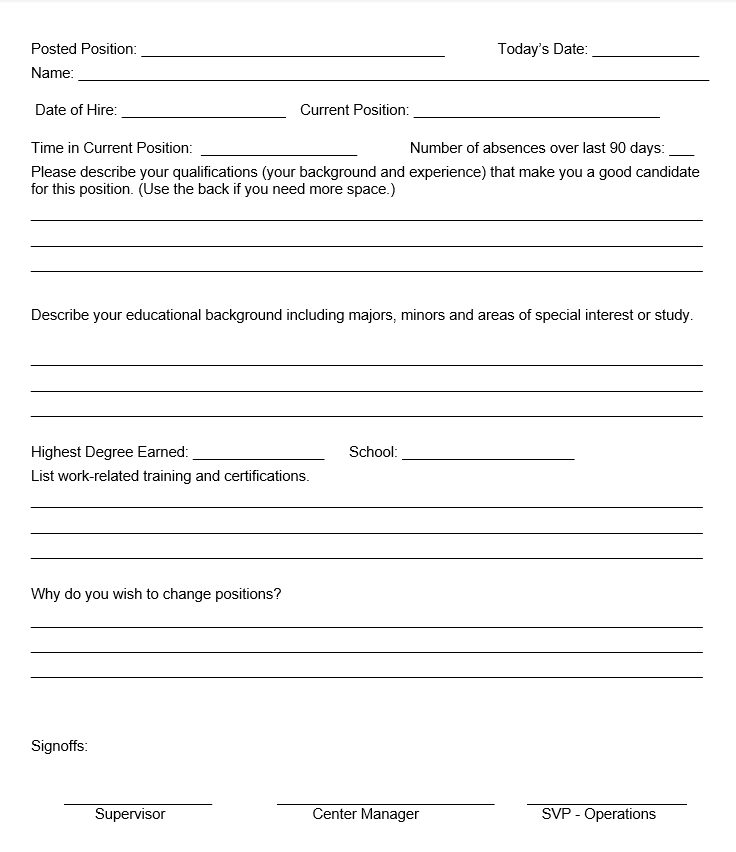
ANNEX 2
Performance Appraisal Forms
Staff
The performance appraisal is a communication tool designed to support each individual’s contribution to the Company. The appraisal provides a way to measure skills and accomplishment with reasonable accuracy and uniformity. It provides a way to help identify obstacles to top performance. It should help identify areas for professional growth. It should not, however, be considered the supervisor’s only communication tool. Open lines of communication throughout the year help to make effective working relationships.
Each employee is entitled to a thoughtful and careful appraisal. Its success depends on the supervisor’s willingness to complete a constructive and objective assessment, and on the employee’s willingness to respond to constructive criticism and to work with the supervisor to overcome performance barriers.
Instructions to Supervisors/Appraisers:
These ratings will represent your evaluation of the employee’s actual job performance during the evaluation period specified. To help you make an objective evaluation, the following are suggested:
- Review the employee’s job description and base your ratings on the requirements of the job as described.
- Evaluate the employee’s proven and observable on-the-job performance.
- Consider one rating factor at a time so that your rating of one trait will not influence your rating of another.
Upon completion, check your ratings and comments. Discuss your ratings with the employee and encourage him/her to make verbal/written comments. The completed form should then be reviewed and signed by the person to whom you report, submitted to HR for any necessary action and maintained in the employee’s file.
Ratings:
Read each of the following performance classifications carefully before conducting this appraisal. Select the terms that best describes the employee’s overall performance and contribution during the past review period in light of his/her job description, predetermined objectives, supervisor expectations, accomplishments.
5 = Outstanding
- Exceeds position requirements even on the most difficult and complex aspects of his/her job
- Consistently accomplishes more than expected
- Takes on additional assignments without negatively affecting other work
- Completes projects thoroughly, completely, and on or ahead of schedule
4 = Exceeds Expectations
- Is doing an excellent job and usually exceeds most requirements
- Demonstrates a willingness to perform beyond expectations
- Takes initiative in asking for additional responsibility
3 = Meets Expectations
- Is doing a satisfactory job
- Handles most assignments within the scope of his/her responsibility
- Does not require significant improvement
- Typically completes regular work and projects on schedule
2 = Needs Improvement
- Some improvement in the quality, quantity, and/or timeliness of work is important
- Regular work and projects are not consistently completed on schedule
1 = Unacceptable
- Does not perform the job satisfactorily
- Does not produce the quantity, quality, and timeliness of work expected
| Performance Factors | Rating |
| Job Knowledge: Understands and applies the principles and procedures required by the job | |
| Quality of Work: Performs the work with accuracy, thoroughness, and effectiveness as it relates to the job description | |
| Productivity: Accomplishes appropriate amount of work, efficient use of time, etc. | |
| Initiative: Organizes own work and time, anticipates need and takes appropriate action, works to improve performance | |
| Dependability: Takes instruction and follows through, takes responsibility on the job and on the task | |
| Interpersonal skills: Establishes positive supportive relationships, works effectively as a team member, good communicator | |
| Attendance and Punctuality: At work on time, maintains work schedule, responsible use of leave |
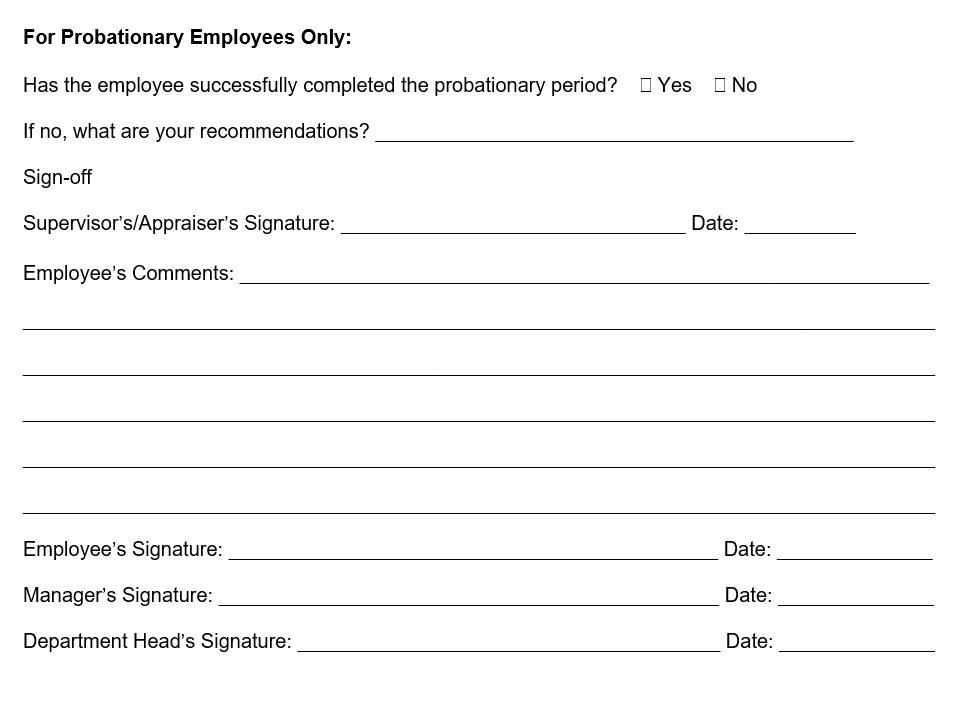
Supervisors
The performance appraisal is a communication tool designed to support each individual’s contribution to the Company. The appraisal provides a way to measure skills and accomplishment with reasonable accuracy and uniformity. It provides a way to help identify obstacles to top performance. It should help identify areas for professional growth. It should not, however, be considered the manager’s only communication tool. Open lines of communication throughout the year help to make effective working relationships.
Each employee is entitled to a thoughtful and careful appraisal. Its success depends on the manager’s willingness to complete a constructive and objective assessment, and on the employee’s willingness to respond to constructive criticism and to work with the manager to overcome performance barriers.
Instructions to Managers:
These ratings will represent your evaluation of the employee’s actual job performance during the evaluation period specified. To help you make an objective evaluation, the following are suggested:
- Review the employee’s job description and base your ratings on the requirements of the job as described.
- Evaluate the employee’s proven and observable on-the-job performance.
- Consider one rating factor at a time so that your rating of one trait will not influence your rating of another
Upon completion, check your ratings and comments. Discuss your ratings with the employee and encourage him/her to make verbal/written comments. The completed form should then be reviewed and signed by the person to whom you report, submitted to HR for any necessary action and maintained in the employee’s file.
Ratings:
Read each of the following performance classifications carefully before conducting this appraisal. Select the terms that best describes the employee’s overall performance and contribution during the past review period in light of his/her job description, predetermined objectives, supervisor expectations, accomplishments.
5 = Outstanding
- Exceeds position requirements even on the most difficult and complex aspects of his/her job
- Consistently accomplishes more than expected
- Takes on additional assignments without negatively affecting other work
- Completes projects thoroughly, completely, and on or ahead of schedule
4 = Exceeds Expectations
- Is doing an excellent job and usually exceeds most requirements
- Demonstrates a willingness to perform beyond expectations
- Takes initiative in asking for additional responsibility
3 = Meets Expectations
- Is doing a satisfactory job
- Handles most assignments within the scope of his/her responsibility
- Does not require significant improvement
- Typically completes regular work and projects on schedule
2 = Needs Improvement
- Some improvement in the quality, quantity, and/or timeliness of work is important
- Regular work and projects are not consistently completed on schedule
1 = Unacceptable
- Does not perform the job satisfactorily
- Does not produce the quantity, quality, and timeliness of work expected
| Performance Factors | Rating |
| Job Knowledge: Understands and applies the principles and procedures required by the job | |
| Quality of Work: Performs the work with accuracy, thoroughness, and effectiveness as it relates to the job description | |
| Productivity: Accomplishes appropriate amount of work, efficient use of time, etc. | |
| Initiative: Organizes own work and time, anticipates need and takes appropriate action, works to improve performance | |
| Dependability: Takes instruction and follows through, takes responsibility on the job and on the task | |
| Interpersonal skills: Establishes positive supportive relationships, works effectively as a team member, good communicator | |
| Attendance and Punctuality: At work on time, maintains work schedule, responsible use of leave | |
| Leadership: Leads by example, motivates staff, fosters teamwork | |
| Planning: Able to plan, prioritize, and organize work of self and others, manages change well | |
| Decision Making: Analyzes situations well, decides what to do, and takes appropriate action | |
| Supervising: Regularly evaluates staff and provides feedback, praising and disciplining appropriately, supports staff development, treats staff in a respectful and consistent manner | |
| Administering: Completes reports and forms in an accurate, timely manner, controls costs/budget |
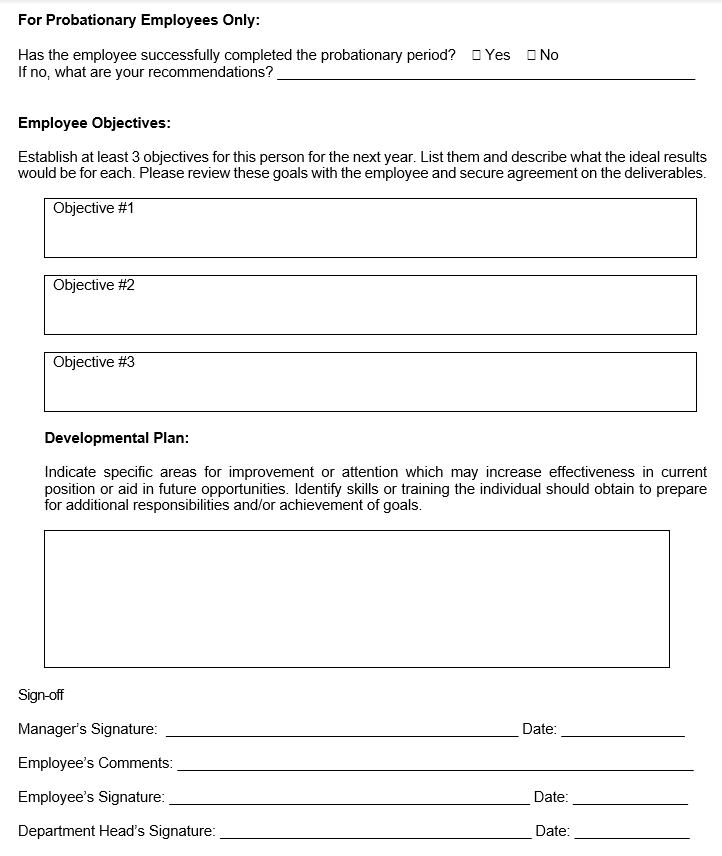
Managers
The performance appraisal is a communication tool designed to support each individual’s contribution to the Company. The appraisal provides a way to measure skills and accomplishment with reasonable accuracy and uniformity. It provides a way to help identify obstacles to top performance. It should help identify areas for professional growth. It should not, however, be considered the manager’s only communication tool. Open lines of communication throughout the year help to make effective working relationships.
Each employee is entitled to a thoughtful and careful appraisal. Its success depends on the manager’s willingness to complete a constructive and objective assessment, and on the employee’s willingness to respond to constructive criticism and to work with the manager to overcome performance barriers.
Instructions to Managers:
These ratings will represent your evaluation of the employee’s actual job performance during the evaluation period specified. To help you make an objective evaluation, the following are suggested:
- Review the employee’s job description and base your ratings on the requirements of the job as described.
- Evaluate the employee’s proven and observable on-the-job performance.
- Consider one rating factor at a time so that your rating of one trait will not influence your rating of another
Upon completion, check your ratings and comments. Discuss your ratings with the employee and encourage him/her to make verbal/written comments. The completed form should then be reviewed and signed by the person to whom you report, submitted to HR for any necessary action and maintained in the employee’s file.
Ratings:
Read each of the following performance classifications carefully before conducting this appraisal. Select the terms that best describes the employee’s overall performance and contribution during the past review period in light of his/her job description, predetermined objectives, supervisor expectations, accomplishments.
5 = Outstanding
- Exceeds position requirements even on the most difficult and complex aspects of his/her job
- Consistently accomplishes more than expected
- Takes on additional assignments without negatively affecting other work
- Completes projects thoroughly, completely, and on or ahead of schedule
4 = Exceeds Expectations
- Is doing an excellent job and usually exceeds most requirements
- Demonstrates a willingness to perform beyond expectations
- Takes initiative in asking for additional responsibility
3 = Meets Expectations
- Is doing a satisfactory job
- Handles most assignments within the scope of his/her responsibility
- Does not require significant improvement
- Typically completes regular work and projects on schedule
2 = Needs Improvement
- Some improvement in the quality, quantity, and/or timeliness of work is important
- Regular work and projects are not consistently completed on schedule
1 = Unacceptable
- Does not perform the job satisfactorily
- Does not produce the quantity, quality, and timeliness of work expected
| Performance Factors | Rating |
| Job Knowledge: Understands and applies the principles and procedures required by the job | |
| Quality of Work: Performs the work with accuracy, thoroughness, and effectiveness as it relates to the job description | |
| Productivity: Accomplishes appropriate amount of work, efficient use of time, etc. | |
| Initiative: Organizes own work and time, anticipates need and takes appropriate action, works to improve performance | |
| Dependability: Takes instruction and follows through, takes responsibility on the job and on the task | |
| Interpersonal skills: Establishes positive supportive relationships, works effectively as a team member, good communicator | |
| Attendance and Punctuality: At work on time, maintains work schedule, responsible use of leave | |
| Leadership: Leads by example, motivates staff, fosters teamwork | |
| Decision Making: Analyzes situations well, decides what to do, and takes appropriate action | |
| Management: Manages staff performance by establishing goals, monitoring performance, providing ongoing feedback to employees, and promoting staff development; takes appropriate action to recognize/reward excellent performance, and corrective action to resolve performance problems | |
| Strategic Planning: Effectively communicates the company’s mission and vision as well as the department’s own, and aligns the department’s priorities accordingly; turns strategies into measurable action plans | |
| Fiscal Responsibility: Effectively manages budgetary/financial matters |
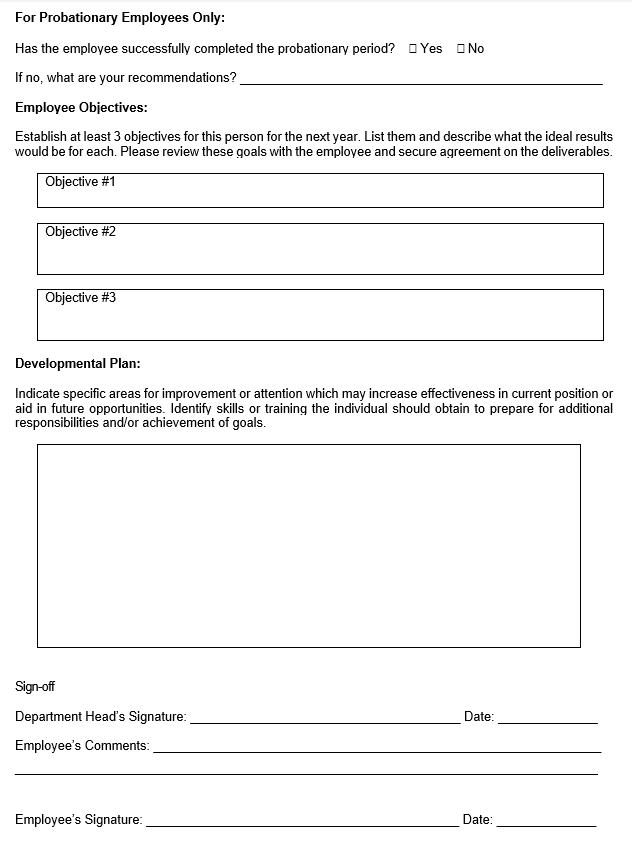
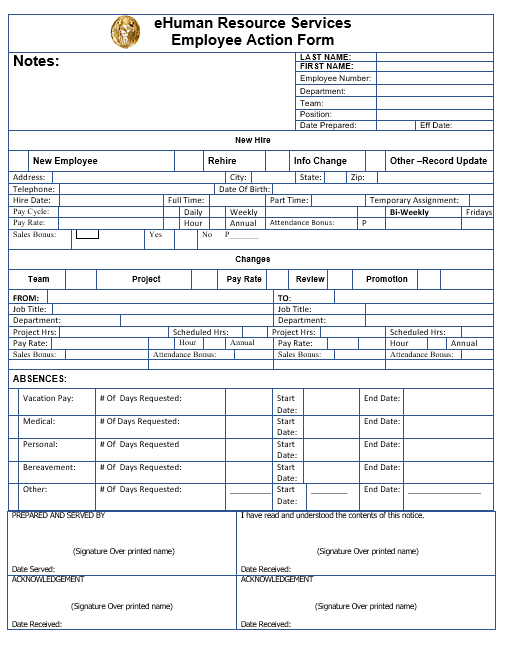
TABLE OF PENALTIES
| VIOLATIONS | 1st Offense | 2nd Offense | 3rd Offense | 4th Offense | 5th Offense |
| A. OFFENSES AGAINST COMPANY INTERESTS | |||||
| 1. Dishonesty | |||||
| a. Falsification or willful misrepresentation of fact in a personal or in any other company record, either when applying for employment or during his employment | Dismissal | ||||
| b. Embezzlement or malversation of company funds; deliberate submission of fraudulent expense statements | Dismissal | ||||
| c. Favoring or conniving with co-employees, suppliers, contractors, creditors, customers, other functionaires for personal or monetary consideration. | Dismissal | ||||
| d. Offering or accepting anything of value in exchange for a job, company benefit, work assignment, better working place or any change in working condition | Dismissal | ||||
| e. Assisting an outsider to misrepresent a transaction with or for the company or misrepresenting the company in a transaction | Dismissal | ||||
| f. Receiving money or other form of compensation or valuable consideration from an outside firm or individual for services or decision rendered in connection with a company transaction or due to connection or influence within the Company | Dismissal | ||||
| g. Failure to report within 48 hours after one has received an erroneous payment or overpayment of salary, commission, allowance other forms of remunerations or reimbursement | Dismissal | ||||
| h. Intentional punching of timecard of another employee; Dismissal having timecard punched by another; unauthorized alterations of time entries | Dismissal | ||||
| i. Failure to punch timecard for no justifiable reason | Warning | Written reprimand | 2 day suspension | 5 day suspension | Dismissal |
| j. Non-verification of timesheet | Reprimand | 2 day suspension | 5 day suspension | Dismissal | |
| k. Giving company identification card to any person not entitled to it, or assisting any person to enter any restricted area | Reprimand | Dismissal | |||
| I. Revealing confidential information to unauthorized personnel, persons or entities without authority. Espionage | Dismissal | ||||
| m. Stealing or attempting to obtain company funds, equipment, products, suppliers and/or materials through fraudulent means from company suppliers, warehouses or other assigned work places | Dismissal | ||||
| n. Distributing unauthorized printed matter in the Company premises without prior authorization from management | 7 to 15 days suspension | Dismissal | |||
| o. Making false statements about the Company or its products and services | 7 to 15 days suspension | Dismissal | |||
| 2. Attendance Policy | |||||
| a. Habitual tardiness (4x or more per week) | Written Warning | Dismissal | |||
| b. Sleeping while on duty | 5 day suspension | Dismissal if committed within 6 months from the date of last offense | |||
| c. Leaving work assignment during working hours or before quitting time without previous permission from immediate supervisor | 2 day suspension | Dismissal | |||
| d.Leaving work assignment or absenting oneself after employee’s request has been refused by superior | 15 day suspension | Dismissal | |||
| e.Wasting time or loitering | Verbal warning | Written reprimand | 2 day suspension | 5 day suspension | Dismissal |
| f.Malingering or feigning of illness | 2 day suspension | 5 day suspension | Dismissal if committed within 12 months from the date of last offense | ||
| g. Absences from work without proper approval or official leave (AWOL/NCNS) for: | |||||
| One (1) day | Written warning | Dismissal | |||
| Two (2) consecutive days | Dismissal | ||||
| h. Refusal to report for duty when requested to perform an assigned task which may result in the loss of life and/or damage to property | Dismissal (if reason is not valid) | ||||
| I.Negligent or careless acts during working time or-on company premises that result in personal injury or damage to property belonging either to a co-employee or that of the Company or of its customers | Written reprimand plus fine, if any | 5 day suspension plus fine, if any | Dismissal | ||
| 3. Insubordination | |||||
| a. Refusal or negligence in obeying a company order | 15 day suspension or dismissal depending on the gravity of the offense | Dismissal | |||
| b. Interfering or refusing to cooperate with a superior; failure or refusal to out lawful written or verbal work instruction of his superior | 15 day suspension or dismissal depending on the gravity of the offense | Dismissal | |||
| c. Refusal to report for duty when so requested or to perform assigned task | 15 day suspension or dismissal depending on the gravity of the offense | Dismissal | |||
| e. Use of abusive language or acts or grave disrespect towards superior or subordinate | 15 day suspension | Dismissal | |||
| f. Engaging in a business or work which renders him a competitor of the Company | Dismissal | ||||
| g. Moonlighting or deriving income during office hours from another employee (non-competitor) | 15 day suspension | Dismissal | |||
| h. Commit abuse of discretion of authority (direct to a subordinate) | Dismissal | ||||
| i. Irresponsible conduct or willful holding back, slowing down, hindering or limiting work output | Dismissal | ||||
| j. Giving false or misleading testimony during company conducted investigation under oath | Dismissal | ||||
| k. Refusal to report to the company doctor or hospital when instructed to do so by management or similar instructions or directions from a supervisor | Written reprimand | 5 day suspension | Dismissal | ||
| l. Using Company time, materials, or other minor equipment to do unauthorized or private work | Written warning | Dismissal | |||
| m. Unauthorized entry in restricted areas | Written reprimand | 5 day suspension | Dismissal | ||
| n. Unauthorized driving or any company moving vehicle; operating or use of machinery when not assigned to such duty | Dismissal | ||||
| o. Failure to report within 24 hours an accident or injury involving company employees, or any other person within company premises, when he has access to such information. | Dismissal | ||||
| p. Holding any unauthorized meeting on company premises that would adversely affect company operations/activities | Dismissal | ||||
| q. Soliciting or collecting contributions for any purpose from co-employees during office hours without authorization from management | Dismissal | ||||
| r. Violation of a safety rule of the company or a violation of general safety work practices, in the performance of work which, among others, include smoking in a restricted area, disregard for the safety of others, etc. | 2 days suspension | 5 days suspension | Dismissal | ||
| s. Encouraging, coercing, inciting, bribing or including any employee to engage in any practice or act in violation of a company policy, rule or regulation | Dismissal | ||||
| t. Committing an act of sabotage | Dismissal | ||||
| B. OFFENSES AGAINST PERSONS | |||||
| a. Attempt on the life of a company officer or employee | Dismissal | ||||
| b. Disorderly conduct during working time or on company premises including among others, fighting, horseplay and threatening or abusing any other employee or person | Dismissal | ||||
| c. Fighting or trying to inflict bodily harm or any person except when in self-defense while within company premises or while performing his job whether within or outside of company premises and whether or not injury actually occurs | Dismissal | ||||
| d. Challenge a co-employee to a fight for any reason | 1 month suspension | Dismissal | |||
| e. Insult, disrespect, threat or intimidation by an employee on the honor or person f a co-employee or third person doing business in the company premises | 5 days suspension | 15 days suspension | Dismissal | ||
| f. Circulating false, untrue, or confidential information affecting the interest of the Company or its officers | Dismissal | ||||
| C. OFFENSES AGAINST PROPERTY | |||||
| a. With malicious intent, cause damage or attempt to damage company equipment or building or damage the property of others on the company time or on company premises | 15 days suspension | Dismissal | |||
| b. Unauthorized possession or use of any company or co-employee’s property, tool, machine, equipment, material | 5 days suspension | 15 days suspension | Dismissal | ||
| c. Substitute company material or equipment with another of inferior quality or of less value | Dismissal | ||||
| d. Obtain or attempt to obtain materials on fraudulent orders | Dismissal | ||||
| e. Cause damage to company equipment or building through reckless impudence (irrespective of the cost of damage) | 5 days suspension | 15 days suspension | Dismissal | ||
| f. Transfer/substitution of company tools, equipment, materials, etc. to another employee without management’s approval | Written reprimand | 2 days suspension | Dismissal | ||
| g. Driving company vehicle recklessly or at speed above the area speed limit, or driving any other vehicle in the same manner within company premises | 2 days suspension | 5 days suspension | Dismissal | ||
| h. Failure to report destruction, damage or loss of company property or spillage of product as soon as practicable when such duty to report pertains to him | 5 days suspension | 15 days suspension | Dismissal | ||
| i. Tampering of materials posted on the bulletin board | Verbal warning | Written reprimand | 2 days suspension | 5 days suspension | Dismissal |
| j. Willful carelessness in the use of the company property | Written reprimand | 2 days suspension | 5 days suspension | Dismissal | |
| k. Negligence or carelessness resulting in loss, wastage or spoilage of Company assets in an amount exceeding Php1,000.00 but less than Php3,000.00 | 7 to 15 days suspension | Dismissal | |||
| l. Defacing any part of Company property like buildings, structures, open areas, etc. (unauthorized painting. marking attaching, setting up, or removal of things) | 7 to 15 days suspension | Dismissal | |||
| m. Damaging or jeopardizing Company interest(s) through acts or omissions which affect Company client(s), supplier(s), official visitor(s) or other business friends of the Management | |||||
| m.1 Stealing from said client(s), supplier(s) or friend(s) of the company | Dismissal | ||||
| m.2 Uttering words, doing acts, or making gestures to said client(s), supplier(s), visitor(s) or friend(s) which are manifestly insulting or grossly disrespectful/discourteous | 7 to 15 days suspension | Dismissal | |||
| m.3 Other culpable acts or omissions | 7 to 15 days suspension | Dismissal | |||
| C. OFFENSES AGAINST SECURITY AND PUBLIC ORDER | |||||
| a. Unauthorized possession or carrying of firearms, explosives, lethal weapons or other prohibited weapons within company premises | Dismissal | ||||
| b. Unauthorized use of fire fighting equipment for purposes other than fighting fire | 2 days suspension | 5 days suspension | Dismissal | ||
| c. Removing safety devices from company machinery, equipment or any property without permission | Dismissal | ||||
| d. Carelessness with regard to safety of fellow employees, with or without serious injury caused; non-observance of safety signs | 2 days suspension | 5 days suspension | Dismissal | ||
| e. Refusal to submit to or failure to meet security rules or requirements of the Company | Written reprimand | 2 days suspension | 5 days suspension | Dismissal | |
| f. Conviction of a criminal offense or commission of a crime | Dismissal | ||||
| g. Allow or fail to report unauthorized persons entering or loitering within one’s work area | Written reprimand | 2 days suspension | 5 days suspension | Dismissal | |
| d. OFFENSES AGAINST PUBLIC MORALS | |||||
| a. Reporting for or performing work while under the influence of intoxicating liquor or narcotics. | 5 days suspension | Dismissal | |||
| b. Drinking or taking intoxicating liquor, drugs or narcotics on company time or premises except when authorized by the Company or medical authority | Dismissal | ||||
| c. Selling or persuading any person to take prohibited/ regulated drugs within company premises except when duly authorized for medical reasons | Dismissal | ||||
| d. Commit grossly indecent conduct or use obscene language in addressing another person in company premises | 15 day suspension | Dismissal | |||
| e. Create or contribute to unsanitary condition or poor housekeeping within company premises | 5 days suspension | 15 days suspension | Dismissal | ||
| f. Taking part in bookmaking, gambling, or any other game of chance on company time or within work premises | Dismissal | ||||